Q1. The sum of the first n even numbers is
Solution

Q2. 228 logs are to be stacked in a store in the following manner : 30 logs in the bottom, 28 in the next row, then 26 and so on. In how many rows can these 228 logs be stacked? How many logs are there in the last row?
Solution
Logs are stacked in the following manner,
30, 28, 26 ....
a = 30,d = 28 - 30 = -2
Sn = [2a + (n - 1) d]
228 =
[2a + (n - 1) d]
228 =  [60 + (n - 1) (-2)]
456 = n [60 - 2n + 2]
456 = n [62 - 2n]
456 = -2n2 + 62n
2n2 - 62n + 456 = 0
n2 - 31n + 228 = 0
n2 - 19n - 12n + 228 = 0
n (n - 19) - 12 (n - 19) = 0
(n - 12) (n - 19) = 0
n = 12, 19
If the last row be 19th
number of logs in the last row will be= a + (n - 1)d
= 30 + 18 (-2)
= 30 - 36
= -6
Since the number of logs cannot be negative, the number of rows should be 12.
Last row will have = 30+(12-1)x(-2)=30 + 11
[60 + (n - 1) (-2)]
456 = n [60 - 2n + 2]
456 = n [62 - 2n]
456 = -2n2 + 62n
2n2 - 62n + 456 = 0
n2 - 31n + 228 = 0
n2 - 19n - 12n + 228 = 0
n (n - 19) - 12 (n - 19) = 0
(n - 12) (n - 19) = 0
n = 12, 19
If the last row be 19th
number of logs in the last row will be= a + (n - 1)d
= 30 + 18 (-2)
= 30 - 36
= -6
Since the number of logs cannot be negative, the number of rows should be 12.
Last row will have = 30+(12-1)x(-2)=30 + 11  (-2)
= 8 logs
(-2)
= 8 logs
[2a + (n - 1) d]
228 = [60 + (n - 1) (-2)]
456 = n [60 - 2n + 2]
456 = n [62 - 2n]
456 = -2n2 + 62n
2n2 - 62n + 456 = 0
n2 - 31n + 228 = 0
n2 - 19n - 12n + 228 = 0
n (n - 19) - 12 (n - 19) = 0
(n - 12) (n - 19) = 0
n = 12, 19
If the last row be 19th
number of logs in the last row will be= a + (n - 1)d
= 30 + 18 (-2)
= 30 - 36
= -6
Since the number of logs cannot be negative, the number of rows should be 12.
Last row will have = 30+(12-1)x(-2)=30 + 11 (-2)
= 8 logs
Q3. Find the sum of the first 10 natural numbers.
Solution
The series is 1,2,3,… 10.

Q4. Check whether  forms an Arithmetic progression or not .If it is an AP then write the common difference and the next two terms.
forms an Arithmetic progression or not .If it is an AP then write the common difference and the next two terms.Solution

Q5. A class X student made plans for his study schedule for the month of February 2008.He decided to increase the number study hours everyday by quarter of an hour.If he started with one hour on the first of February how many hours of studies canhe put in by the end of February 2008?
Solution
Here we essentially need to find the sum of an A.P. with first term a=1, the common difference d=0.25 hours (quarter of an hour)
And n=29 (as the year 2008 will have 29 days in the month of February)
We know that for an A.P. with first term as ‘a’ and common diference as ‘d’ the sum of first n terms is given by
 So the student can put in 130.5 hours of studies by the end of February 2008
So the student can put in 130.5 hours of studies by the end of February 2008
Q6. Find the sum of the following arithmetic series:
−2, −4, −6,…, −100
Solution
Here, a = −2 and d = −2 and an = −100
⇒ a + (n − 1)d = −100
⇒ (−2) + (n − 1) × (−2) = −100
⇒ −2− 2n +2 = −100
⇒ −2n = −100
⇒ n = 50
Therefore, the required sum of the series = [2 × −2 + (50− 1) × −2]
= 25[−4 −98]
= 25 × −102
= −2550
[2 × −2 + (50− 1) × −2]
= 25[−4 −98]
= 25 × −102
= −2550
[2 × −2 + (50− 1) × −2]
= 25[−4 −98]
= 25 × −102
= −2550
Q7. The sum of five consecutive numbers is 100. Find the first number.
Solution
5 consecutive numbers form an arithmetic progression with difference 1.n = 5,S5 = 100,d = 1Let the first number be a.
It is unknown.

Q8. Which term of the AP 3, 8, 13, 18,… will be 55 more than its 20th term?
Solution
3, 8, 13, 18,…
a = 3, d = 8 - 3 = 5 According to the question,Tn = 55 + T20
∴Tn= 55 + a + 19d
∴Tn = 55 + 3 + 19 × 5
∴Tn = 153
∴a + (n - 1)d = 153
∴3 + (n - 1) × 5 = 153
∴5(n - 1) = 150
∴n - 1 = 30
∴n = 31
Q9. There is a race , in which, every participant starts from a bucket, picks up the nearest ball and runs back to drop it in the bucket. Then again, he or she runs back to nearest ball and runs back to drop it in the bucket. Each participant continues like this in the same way until all the balls are in the bucket.
 The balls are kept at a distance of 4 m from each other and there are 8 balls in all. How much distance does each participant needs to travel in order to finish the race?
The balls are kept at a distance of 4 m from each other and there are 8 balls in all. How much distance does each participant needs to travel in order to finish the race?Solution
Distance travelled by the participant in order to pick up the first ball and drop it in the bucket= 4 + 4 = 8 m
Distance travelled by the participant to pick up the second ball and drop it in basket = 4 + 4 + 4 + 4 = 16 m
Similarly, distance travelled by competitor to pick up third, fourth, fifth, sixth, seventh, and eighth balls are 24 m, 32 m, 40 m, 48 m, 56 m, 64 m
a = 8 m
common difference = d = 8m
 So, each participant has to cover a distance of 288 m in order to complete the race
a = 8 m
common difference = d = 8m
So, each participant has to cover a distance of 288 m in order to complete the race
Q10. A manufacturer of radio sets produced 600 units in the 3rd year and 700 units in the 7th year. Assuming that the production uniformly increases by fixed number every year. Find (a) the production in the 1st year
(b) the total production in 7 years
(c) the production in the 10th year.
Solution
Given that the production uniformly increases by fixed number every year. So, the production in each year forms an AP.
Let the AP be a, a + d, a + 2d, ……
Production in the third year = a3 = a + 2d = 600… (1)
Production in the seventh year = a7 = a + 6d = 700 … (2)
Subtracting (1) from (2), we get:
4d = 100  d = 25
From (1), we get:
a = 600 - 50 = 550
Thus, production in the first year is 550 units.
Total production in 7 years = S7 =
d = 25
From (1), we get:
a = 600 - 50 = 550
Thus, production in the first year is 550 units.
Total production in 7 years = S7 =  =
=  =
=  = 4375
Thus, the total production in 7 years is 4375 units.
Production in the 10th year = a10 = a + 9d = 550 + 9
= 4375
Thus, the total production in 7 years is 4375 units.
Production in the 10th year = a10 = a + 9d = 550 + 9  25 = 775 units
d = 25
From (1), we get:
a = 600 - 50 = 550
Thus, production in the first year is 550 units.
Total production in 7 years = S7 =
=
=
= 4375
Thus, the total production in 7 years is 4375 units.
Production in the 10th year = a10 = a + 9d = 550 + 9 25 = 775 units
Q11. Find the sum of the following arithmetic series:
2 + 4 + 6+ … to 10 terms
Solution
The sum of the first n terms of the AP whose first term = a and common difference = d is given by

Q12. The next term of the A.P.  ... is:
... is:-
1)

-
2)

-
3)

-
4)

Solution
Common difference = 

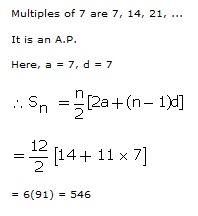
Q13. Find the sum of first twelve multiples of 7.
Solution
Q14. Sum of
the first n terms of an A.P. is 5n2 - 3n. Find the A.P. and also
find its 16th term.
Solution
Sum
of the n terms of an A.P. is 5n2 - 3n. Find the terms of the A.P.
and also find the 16th term.
Sn
= 5n2 - 3n  an
= Sn - Sn - 1
an
= 5n2 - 3n - [5(n - 1)2 - 3 (n - 1)]
an
= 5n2 - 3n -[5(n2 - 2n + 1) - 3n + 3]
an
= 5n2 - 3n - 5n2 + 10n - 5 + 3n - 3
an
= 10n - 8
a1
= 2
a2
= 20 - 8 = 12
a3
= 30 - 8 = 22
a16
= 160-8= 152
an
= Sn - Sn - 1
an
= 5n2 - 3n - [5(n - 1)2 - 3 (n - 1)]
an
= 5n2 - 3n -[5(n2 - 2n + 1) - 3n + 3]
an
= 5n2 - 3n - 5n2 + 10n - 5 + 3n - 3
an
= 10n - 8
a1
= 2
a2
= 20 - 8 = 12
a3
= 30 - 8 = 22
a16
= 160-8= 152
an
= Sn - Sn - 1
an
= 5n2 - 3n - [5(n - 1)2 - 3 (n - 1)]
an
= 5n2 - 3n -[5(n2 - 2n + 1) - 3n + 3]
an
= 5n2 - 3n - 5n2 + 10n - 5 + 3n - 3
an
= 10n - 8
a1
= 2
a2
= 20 - 8 = 12
a3
= 30 - 8 = 22
a16
= 160-8= 152
Q15. What is the common difference of the A.P. in which a18 - a14 = 32?
Solution
We know an = a + (n - 1)d, where a is the first term and d is the common difference.
a18 - a14 = 32
a + (18 - 1)d - [a + (14 - 1)d] = 32
17d - 13d = 32
d =  d = 8
Common difference is 8.
d = 8
Common difference is 8.
d = 8
Common difference is 8.
Q16. Find the sum of all 15 terms of an AP whose middle-most term is 56.
Solution
LetA = first term and d = common difference of the given AP.
In an AP consisting of 15 terms,  i.e. 8th term is the middle term.
Given: middle term = 56
∴ a + 7d = 56 … (i)
We know
i.e. 8th term is the middle term.
Given: middle term = 56
∴ a + 7d = 56 … (i)
We know  that
that

i.e. 8th term is the middle term.
Given: middle term = 56
∴ a + 7d = 56 … (i)
We know that
Q17. If the first term of an AP is 252 and the common difference is 3, then the last term is 999 and the number of terms is 250, then what is the sum of the AP?
Solution

Q18. Find the sum of 1+ 4 + 7 + 10 + 13 + …40.
Solution
Let there be n terms in the givenarithmetic series, then
an= 40
⇒ a + (n − 1)d = 40
⇒ 1 + (n − 1) × 3 = 40
⇒ 1 + 3n − 3 = 40
⇒ 3n − 2 = 40
⇒ 3n = 42
⇒ n = 14
Therefore, the required sum of the series = [2 × 1 + (14− 1) × 3]
= 7 [2 + 13 × 3]
= 7 [2 + 39]
= 7 × 41
= 287
[2 × 1 + (14− 1) × 3]
= 7 [2 + 13 × 3]
= 7 [2 + 39]
= 7 × 41
= 287
[2 × 1 + (14− 1) × 3]
= 7 [2 + 13 × 3]
= 7 [2 + 39]
= 7 × 41
= 287
Q19. 15th term of the A.P. x - 7, x - 2, x + 3 ... is:
Solution
a1 = x - 7
a2 = x - 2
common difference = d = x - 2 - (x - 7) = 5
15th term:
a15 = a1 + (n - 1)d
a15 = x - 7 + (15 - 1) x 5
= x + 63
Q20. Find the sum of the AP −26, −24, −22,…to the 36th term.
Solution
Here, a = −26 and d = −24 − (−26) = −24 + 26 = 2

Q21. Find the common difference of an A.P. whose first term is  and the 8th term is
  . Also, write its 4th term.
and the 8th term is . Also, write its 4th term. Solution
 t8 = a + 7d



Q22. Find three numbers in A.P. whose sum is 15 and the product is 80.
Solution
 25 - d2 = 16
  d2 = 9 d =
  3
When d = 3, the numbers are 2, 5, 8
When d = -3, the numbers are 8, 5, 2
3
When d = 3, the numbers are 2, 5, 8
When d = -3, the numbers are 8, 5, 2
Q23. Which of the following is the formula for the sum of the first n natural numbers?
-
1)

-
2)

-
3)

-
4)

Solution
Sum of the first n natural numbers =
Q24. Write the next two terms of the following
AP: 3, 1, -1, -3, ……..?
Solution
A. P is 3, 1, -1, - 3……
Here  Common difference

Common difference
Q25. The common difference of an A.P. in which a25 - a12 = - 52 is:
Solution
We know an = a + (n - 1)d, where a is the first term and d is the common difference.
a25 - a12 = - 52
a + (25 - 1)d - [a + (12 - 1)d] = - 52
24d - 11d = - 52
d = 
Q26. Which term of the A.P. 1, 4, 7 ... is 88?
Solution
The given sequence is 1, 4, 7, …
This is an AP with first term (a) = 1 and common difference (d) = 3
Let an = 88
a + (n - 1)d = 88
1 + (n - 1)(3) = 88
3(n - 1) = 87
n = 29 + 1 = 30
Thus, 88 is the 30th term of the given sequence.
Q27. The sum of the third and seventh term of an A.P. is 6 and their product is 8. Find the sum of the first sixteen terms of the A.P.
Solution
Let the A.P. be a, a + d, a + 2d, ......

 t3 + t7 = 6
 2a + 8d = 6
a + 4d = 3
a = 3 - 4d… (1)
(a + 2d) (a + 6d) = 8
Using (1), we get,
(3 - 2d) (3 + 2d) = 8
9 - 4d2 = 8
2a + 8d = 6
a + 4d = 3
a = 3 - 4d… (1)
(a + 2d) (a + 6d) = 8
Using (1), we get,
(3 - 2d) (3 + 2d) = 8
9 - 4d2 = 8
 If
If  If
If 
t3 + t7 = 6
2a + 8d = 6
a + 4d = 3
a = 3 - 4d… (1)
(a + 2d) (a + 6d) = 8
Using (1), we get,
(3 - 2d) (3 + 2d) = 8
9 - 4d2 = 8
If
If
Q28. A sum of Rs. 700 is to be used to give seven cash prizes to students of a school for their overall academic performance. If each prize is Rs. 20 less than it preceding prize, find the value of each of the prizes.
Solution
Let the value of the prices be
x, x - 20, x - 40, .....
This is an arithmetic sequence with first term (a) = x and common difference (d) = -20.
Given,
S7 = 700
Sn = [2a + (n - 1)d]
 Thus, the values of the prizes are Rs. 160, Rs. 140, Rs. 120, Rs. 100, Rs. 80, Rs, 60, and Rs. 40.
[2a + (n - 1)d]
Thus, the values of the prizes are Rs. 160, Rs. 140, Rs. 120, Rs. 100, Rs. 80, Rs, 60, and Rs. 40.
Q29. In an AP, if the 5th and 12th terms are 30 and 65, respectively, what is the sum of the first 20 terms?
Solution
Here, a5 = a + 4d = 30 and a12 = a + 11d = 65
a + 4d = 30 … (i)
a + 11d = 65 … (ii)
Solving both equations, we get
a = 10 and d = 5

Q30. Find the 10th term from the end of the A.P.series 4,9,14, ..... 254.
Solution
AP in reverse order : 254, ..... , 14,9,4
a = 254
d = 4 - 9 = -5
a10 = a + (10 - 1)d
= 254 + 9 x (-5)
= 209
 10th term from the end of given AP = 209
10th term from the end of given AP = 209
Q31. Find
the sum of all multiples of 9 lying between 300 and 700.
Solution
The
multiples of 9 lying between 300 and 700 are
306,
315, ..... 693
This
is an AP with
first
term, a = 306 and common difference, d = 9

Q32. Find the sum of the following arithmetic series:
7, 10, 13,… to 14 terms
Solution

Q33. An organization has new officers for the year and is ordering new stationery. In January, a mailing is sent to the 136 current members. If the membership increases each month by 6 members, how many envelopes will be needed for one year’s monthly mailings?
Solution
In January, number of envelopes sent = 136
In February, number of envelopes needed = 142
In March, number of envelopes needed = 148
In April, number of envelopes needed = 154
In May, number of envelopes needed = 160 and so on…………………..
The number of envelopes required form an arithmetic progression with the first term (a) = 136 and common difference = 142 – 136 = 6
We will have to find the sum of the first 12 terms of our arithmetic progression in this case to find the total number of envelopes needed for one year’s monthly mailings.
 Hence, total required envelopes in a year = 2028
Hence, total required envelopes in a year = 2028
Q34. A man saves Rs. 200 in each of the first three months of his service. In each of the subsequent months, his savings increase by Rs. 40 more than the savings of the immediately previous month. His total savings from the start of service will be Rs. 11040 after how many months?
Solution
According to the question, the series is 200, 200, 200, 240, 280, 320,…
Sum of the series = 11040 200 + 200 + 200 + 240 + 280 + 320,… = 11040 200 + 240 + 280 + 320,…. = 11040 - 400 200 + 240 + 280 + 320,…. = 10640 a = 200, d = 40
∴ ∴n(400 + 40n - 40) = 21280
∴n(40n + 360) = 21280
∴40n(n + 9) = 21280
∴n(n + 9) = 532
∴n(n + 9) = 28 × 19
∴n = 19 Hence, his total savings from the start of service will be Rs. 11040 after 19+2 = 21 months.
∴n(400 + 40n - 40) = 21280
∴n(40n + 360) = 21280
∴40n(n + 9) = 21280
∴n(n + 9) = 532
∴n(n + 9) = 28 × 19
∴n = 19 Hence, his total savings from the start of service will be Rs. 11040 after 19+2 = 21 months.
∴n(400 + 40n - 40) = 21280
∴n(40n + 360) = 21280
∴40n(n + 9) = 21280
∴n(n + 9) = 532
∴n(n + 9) = 28 × 19
∴n = 19 Hence, his total savings from the start of service will be Rs. 11040 after 19+2 = 21 months.
Q35. If mtimesthe mthterm of an AP is equal to n times the nthterm and m ≠ n, then (m + n)th term is
Solution
According to the question, Tm = n a + (n - 1)d = n … (i)Tn = m a + (m - 1)d = m … (ii)mTm= n Tn
∴ m[a + (m - 1)d] = n [a + (n - 1)d]
∴ ma - na + m (m - 1)d - n (n - 1)d = 0
∴ a (m - n) + m2 - md - n2 + nd = 0
∴ a (m - n) + (m - n)(m + n) - (m - n)d = 0
∴ (m - n)[a + (m + n - 1)d] = 0
∴ a + (m + n - 1)d = 0
∴ Tm + n = 0
Q36. Find the sum of the first 20 terms of an AP in which the first term is −1 and the third term is7.
Solution
Here, a = −1 and a3 = 7
∴a + 2d = 7
∴−1 + 2d = 7
∴ d = 4

Q37. Find the sum of the first 30 positive integers divisible by 3 and 2 both.
Solution
The numbers which are divisible by by 3 and 2 both are the numbers that are divisible by 6.
So first 30 such numbers would be forming an A.P.with 6 as the fist term and 6 as the common difference
So we should find the sum
6+12+18+… to 30 terms
We know that for an A.P. with first term as ‘a’ and common diference as ‘d’ the sum of first n terms is given by
 =
= So in this case we get,
 =
= =2790
=2790
=
So in this case we get,
=
=2790
Q38. Which term of the A.P. 92, 88, 84, 80 ... is 0?
Solution
Let the nth of the given AP be 0.
We know that, the nth term of an AP is given by a + (n - 1)d, where a is its first term and d is its common difference.
Here, a = 92 and d = 88 - 92 = - 4
 0 = 92 + (n - 1) (- 4)
0 = 92 - 4n + 4
4n = 96
n = 24
Thus, the 24th term of the given AP is 0.
0 = 92 + (n - 1) (- 4)
0 = 92 - 4n + 4
4n = 96
n = 24
Thus, the 24th term of the given AP is 0.
0 = 92 + (n - 1) (- 4)
0 = 92 - 4n + 4
4n = 96
n = 24
Thus, the 24th term of the given AP is 0.
Q39. The first term of an A.P. is 5 and its 100th term is –292. Find the 50th term of this A.P.
Solution
Let the A.P. be  Here, a1 = 5
 We have



 d = –3
Also
d = –3
Also 
 50th term is –142.
Here, a1 = 5
We have
d = –3
Also
50th term is –142.
Q40. Which term of the A.P. 21, 42, 63, 84, …… is 420 ?
Solution
Given A.P. is 21, 42, 63, 84, ….. 420


Q41. Find the  terms of the sequence defined by

terms of the sequence defined by
Solution
For n = 5 which is an odd natural number we have
 For n = 8 which is an even natural number
an = n(n+1) = 8(8+1) = 8 x 9 = 72
For n = 8 which is an even natural number
an = n(n+1) = 8(8+1) = 8 x 9 = 72
For n = 8 which is an even natural number
an = n(n+1) = 8(8+1) = 8 x 9 = 72
Q42. If p - 1, p + 3, 3p - 1 are in A.P., then p is equal to:
Solution
p - 1, p + 3, 3p - 1 are in A.P.
 p + 3 - p + 1 = 3p - 1 - p - 3
4 = 2p - 4
2p = 8
p = 4
p + 3 - p + 1 = 3p - 1 - p - 3
4 = 2p - 4
2p = 8
p = 4
p + 3 - p + 1 = 3p - 1 - p - 3
4 = 2p - 4
2p = 8
p = 4
Q43. Find the sum of the given AP:
3, 9, 15,…99, where the number of terms is 17.
Solution

Q44. Write the next two terms of the following sequence

Solution
 First term


Q45. Find the sum of 30 terms of the AP 1, 4, 7, 10,…
Solution

Q46. Which of the following is the formula for the sum of the n terms of an AP?
-
1)

-
2)

-
3)

-
4)

Solution

Q47. In
November 2009, the number of visitors to a zoo increased daily by 20. If a
total of 12300 people visited the zoo in that month, find the number of
visitors on 1st Nov. 2009.
Solution
Let
number of visitors in zoo on 1st November be x Then the daily
visitors in November in the zoo are:
x,
x + 20 ...
This
will form an AP with first term x and common difference 20.
Total
no. of visitors in Nov. = 12300 (Given)
 S30 = 12300
 12300
= 15 (2x + 29
12300
= 15 (2x + 29  20)
= 30 x + 8700
x
= 120
Number of visitors on 1st Nov.
2009 = 120.
20)
= 30 x + 8700
x
= 120
Number of visitors on 1st Nov.
2009 = 120.
S30 = 12300
12300
= 15 (2x + 29 20)
= 30 x + 8700
x
= 120
Number of visitors on 1st Nov.
2009 = 120.
Q48. 8th term of an A.P. is 37 and its 12th term is 57. Find the A.P.
Solution
Let a be the first term and d be the common difference of the AP.
We know that the nth term of an AP is given by:

 Thus, the A.P. is 2, 7, 12, ...
Thus, the A.P. is 2, 7, 12, ...
Q49. How many terms of the A.P. 78, 71, 64, ..... are needed to give the sum 465? Also find the last term of this A.P.
Solution
a = 78, d = 71 - 78 = -7
Let n be the required no. of terms
Sn = 465

 [2a + (n - 1)d] = 465
n[156 + (n - 1) (-7)] = 930
7n 2 - 163n + 930 = 0
(7n - 93) (n - 10) = 0
n =
[2a + (n - 1)d] = 465
n[156 + (n - 1) (-7)] = 930
7n 2 - 163n + 930 = 0
(7n - 93) (n - 10) = 0
n =  or n = 10
Neglect n = as n cannot be a fraction
or n = 10
Neglect n = as n cannot be a fraction
 No. of terms (n) = 10
[2a + (n - 1)d] = 465
n[156 + (n - 1) (-7)] = 930
7n 2 - 163n + 930 = 0
(7n - 93) (n - 10) = 0
n = or n = 10
Neglect n = as n cannot be a fraction
No. of terms (n) = 10
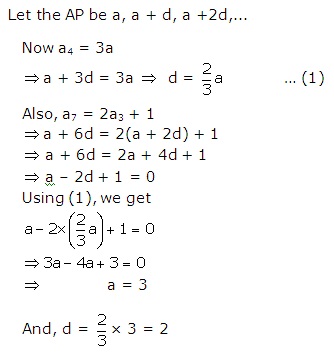
Q50. The 4th term of an A.P. is equal to 3 times the first term and the 7th term exceeds twice the 3rd term by 1. Find the A.P.
Solution
Let a and d respectively be the first term and the common difference of the AP.
nth term = an = a + (n - 1)d
Given, a4 = 3a

 From (1), 2a = 6
a = 3
From (1), 2a = 6
a = 3
 A.P. is 3, 5, 7, ...
From (1), 2a = 6
a = 3
A.P. is 3, 5, 7, ...
Q51. A sum
of Rs. 700 is to be used for giving 7 cash prizes to students of a school for
their academic performance. If each prize is Rs. 20 less than its preceding
prize, find the value of each of the prizes.
Solution
The
value of prizes will form an AP with common difference (d) = -20.
We
know that the sum of n terms of an AP is given by:
Sn =  It is given that S7 =
700
It is given that S7 =
700
 700
=
700
= 
 200 = 2a - 120
a = 160
Thus, the cash prizes are 160,
140, 120, 100, 80, 60, 40
200 = 2a - 120
a = 160
Thus, the cash prizes are 160,
140, 120, 100, 80, 60, 40
It is given that S7 =
700
700
=
200 = 2a - 120
a = 160
Thus, the cash prizes are 160,
140, 120, 100, 80, 60, 40
Q52. In an A.P., prove that am + n + am - n = 2 am, where an denotes nth term of the A.P.
Solution
We know that nth term of an AP is given by an = a + (n - 1)d.
am + n = a + (m + n - 1) d… (i)
am - n = a + (m - n - 1) d… (ii)
am = a + (m - 1) d… (iii)
Adding (i) and (ii),
 = 2a + 2d (m - 1)
= 2 [a + (m - 1)d]
= 2am
= 2a + 2d (m - 1)
= 2 [a + (m - 1)d]
= 2am
= 2a + 2d (m - 1)
= 2 [a + (m - 1)d]
= 2am
Q53. Vikram invested a certain amount in shares. The stock market, in that year, reached new heights throughout. The stock market grew at a rate such that his investment grew by a fixed amount every month. As a result, after four months, his investment became Rs. 10,000 and after nine months, it became Rs. 17,500. What amount will Vikram have after the twelfth month?
Solution
Let the initial amount invested by Vikram be Rs.a.
Let his investment increase by Rs.d each month.
Initial investment = a
Thus, investment after the 1st month = a + d
Investment after the 2nd month = a + 2d.
Investment after the nth month
= a + nd
Investment after the 4th month
= a + 4d = 10,000 … (1)
Investment after the 9th month
= a + 9d = 17,500 … (2)
Subtracting (1) from (2):
9d – 4d = 17,500 – 10,000
5d = 7,500
d = 1500
Substituting the value of d in (1):
a + 4(1500) = 10,000
a = 10,000 – 6000
a = 4000
Thus, he invested Rs.4,000 in the stock market and his investment grew by Rs.1500 each month.
Thus, after the 12th month, his investment became a + 12d
= Rs. 4,000 + 12 x (1500)
= Rs. 4,000 + 18,000
= Rs. 22,000
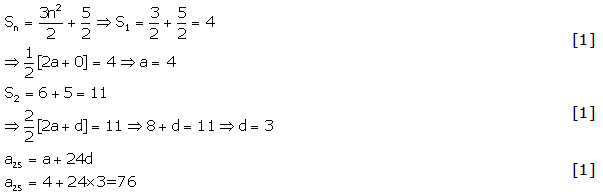
Q54. 
Solution
Q55. The 4th term of an AP is equal to 3 times the first term and the 7th term exceeds twice the 3rd term by 1. Find the first term and the common difference.
Solution
Q56. In a flower bed, there are 31 rose plants in the first row, 28 in the second, 25 in the third, and so on. There are 7 rose plants in the last row. How many rows are there in the flower bed?
Solution
The number of rose plants in the 1st, 2nd, 3rd … rows are 31, 28, 25 … 7
These numbers are in an AP.
Let the number of rows in the flower bed be n.
Then a = 31, d = 28 – 31 = – 3, an = 7
an = a + (n – 1) d
Thus, 7 = 31 + (n – 1)(– 3)
i.e., – 24 = (n – 1)(– 3)
i.e. 8 = n - 1
i.e., n = 9
So, there are 9 rows in the flower bed.
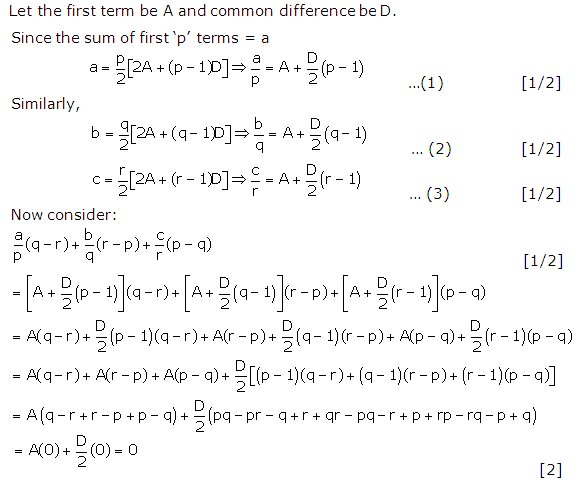
Q57. 
Solution
Q58. A spiral is made up of successive
semicircles, with centres alternately at A and B, starting from A, of radius
0.5 cm, 1 cm, ..... What is the total length of such a spiral made up of
thirteen consecutive semicircles?
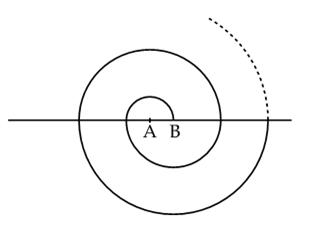
Solution
Circumference
of a semi-circle =  =
=  r
Total
length
=
r1 + r2 + r3 + ...
=
(0.5 + 1 + 1.5 + ..... upto 13 terms)
=
r
Total
length
=
r1 + r2 + r3 + ...
=
(0.5 + 1 + 1.5 + ..... upto 13 terms)
=


= r
Total
length
=
r1 + r2 + r3 + ...
=
(0.5 + 1 + 1.5 + ..... upto 13 terms)
=
Q59. Kartik repays his total loan of Rs. 1,18,000 by paying every month starting with the first instalment of 1000, if he increases the instalment by Rs. 100 every month. What amount will be paid by him in the 30th instalment? What amount of loan does he still have to pay after the 30th instalment?
Solution
Total amount of loan = Rs 1,18,000
Since the amount of each installment increases by Rs 100 every month, therefore, the installments paid are in A.P.
Amount of first installment, a = Rs 1000
Increase in amount of each installment, d = Rs 100
Amount to be paid in 30th instalment = a30
a30 = a + (n - 1)d
= 1000 + 29  100
= 1000 + 2900
= Rs. 3900
Amount of loan to be still paid after paying the 30th installment
= Total amount of loan - Total amount paid by him in 30 installments
Amount paid in 30 instalments = S30
S30 = [2a + (n - 1)d]
= 15[2000 + 2900] = 15 4900 = 73,500
Amount of loan to be still paid after paying the 30th installment = Rs 1,18,000 - Rs 73,500 = Rs 44,500
100
= 1000 + 2900
= Rs. 3900
Amount of loan to be still paid after paying the 30th installment
= Total amount of loan - Total amount paid by him in 30 installments
Amount paid in 30 instalments = S30
S30 = [2a + (n - 1)d]
= 15[2000 + 2900] = 15 4900 = 73,500
Amount of loan to be still paid after paying the 30th installment = Rs 1,18,000 - Rs 73,500 = Rs 44,500
100
= 1000 + 2900
= Rs. 3900
Amount of loan to be still paid after paying the 30th installment
= Total amount of loan - Total amount paid by him in 30 installments
Amount paid in 30 instalments = S30
S30 = [2a + (n - 1)d]
= 15[2000 + 2900] = 15 4900 = 73,500
Amount of loan to be still paid after paying the 30th installment = Rs 1,18,000 - Rs 73,500 = Rs 44,500
Q60. Find
the sum of the first 50 odd natural numbers.
Solution
50
odd natural numbers are 1,3,5,...an
Sn
= n/2[2a+(n-1)d]= n/2(2x1 + 49x2)
= 50/2 (100)
= 2500
Q61. How many terms of the A.P. 9,17,25, ..., must be taken to get a sum of 450?
Solution
a = 9, d = 8, Sn = 450
Sn = [2a + (n - 1) d]
450 = [18 + (n - 1) (8)]
450 = 4n2 + 5n
4n2 + 5n - 450 = 0
4n2 - 40n + 45n - 450 = 0
4n (n - 10) + 45 (n - 10) = 0
(n - 10) (4n + 45) = 0
n =  or n = 10
Rejecting n =
or n = 10
Rejecting n =  as number of terms can not be negative.
 n = 10
Thus, ten terms of the given A.P. will make sum as 450.
n = 10
Thus, ten terms of the given A.P. will make sum as 450.
[2a + (n - 1) d]
450 = [18 + (n - 1) (8)]
450 = 4n2 + 5n
4n2 + 5n - 450 = 0
4n2 - 40n + 45n - 450 = 0
4n (n - 10) + 45 (n - 10) = 0
(n - 10) (4n + 45) = 0
n = or n = 10
Rejecting n = as number of terms can not be negative.
n = 10
Thus, ten terms of the given A.P. will make sum as 450.
Q62. Find
the sum of all three digit numbers which leave the same remainder 2 when
divided by 5.
Solution
The
three digit numbers which leave the same remainder 2 when divided by 5 are
102,
107, ..... 997
This
is an AP.
First
term, a = 102
Common
difference, d = 5
Last
term, an = 997
We
know that the nth term of an AP is given by:
an
= a + (n - 1)d
 Sn
=
Sn
=  [a + l] =
 [102 + 997] =
90 1099 = 98910
Hence,
the required sum of all three digit numbers which leave the same remainder 2
when divided by 5 is 98910.
[102 + 997] =
90 1099 = 98910
Hence,
the required sum of all three digit numbers which leave the same remainder 2
when divided by 5 is 98910.
Sn
= [a + l] = [102 + 997] =
90 1099 = 98910
Hence,
the required sum of all three digit numbers which leave the same remainder 2
when divided by 5 is 98910.
Q63. Which term of the A.P. 3, 15, 27, 39, ... will be 132 more than its 60th term?
Solution
First term = a = 3
Common difference = d = 15 - 3 = 12
We know that the nth term of an AP is given by:
an = a + (n - 1)d
 a60 = 3 + (60 - 1) 12 = 3 + 708 = 711
Now, we need to find which term is 132 more than 60th term.
132 + 711 = 843
a60 = 3 + (60 - 1) 12 = 3 + 708 = 711
Now, we need to find which term is 132 more than 60th term.
132 + 711 = 843

a60 = 3 + (60 - 1) 12 = 3 + 708 = 711
Now, we need to find which term is 132 more than 60th term.
132 + 711 = 843
Q64. Find the sum of all two-digit odd positive numbers.
Solution
Two digit odd positive numbers are 11, 13, 15, ...., 99.
This is an A.P. with,
First term, a = 11, Common difference, d = 13 - 11 = 2, and last term, an = 99
Now, an = a + (n - 1)d
 99 = 11 + (n - 1)2
99 = 11 + 2n - 2
99 = 11 + (n - 1)2
99 = 11 + 2n - 2
 99 = 9 + 2n
2n = 90
n = 45
99 = 9 + 2n
2n = 90
n = 45
 Thus, the sum of all two-digit odd positive numbers is 2475.
99 = 11 + (n - 1)2
99 = 11 + 2n - 2
99 = 9 + 2n
2n = 90
n = 45
Thus, the sum of all two-digit odd positive numbers is 2475.
Q65. Find the number of terms of the series:
-5 + (-8) + (-11) + ...... + (-230)
Solution
-5 + (-8) + (-11) + ...... + (-230)
The series -5, -8, -11, … -230 is an arithmetic progression with
First term, a = -5
Common difference, d = -3
Let an = -230
-230 = a + (n - 1)d
-230 = -5 + (n - 1)(-3)
-230 = -5 - 3n + 3
-228 = -3n
n = 76
Thus, there are 76 terms in the given sequence.
Q66. Which term of the Arithmetic Progression 3, 10, 17,…. Will be 84 more than its 13th term?
Solution

Q67. Find the sum of the first 31 terms of an A.P. whose nth term is given by 3 +  n.
n.
n.Solution



 =
=  Thus, the sum of the first 31 terms of the A.P. is
  .
.
Q68. The sum of the first three terms of an A.P. is 33. If the product of the first and the third term exceeds the second term by 29, find the A.P.
Solution
Let the terms in AP be (a - d), a, (a + d).
Sum of the three terms = a - d + a + a + d = 3a
 3a = 33
a = 11
Also, from the given information, we have:
(a - d)(a + d) = a + 29
a2 - d2 = 11 + 29 = 40
121 - d2 = 40
d2 = 81
d =
3a = 33
a = 11
Also, from the given information, we have:
(a - d)(a + d) = a + 29
a2 - d2 = 11 + 29 = 40
121 - d2 = 40
d2 = 81
d =  9
Thus, the AP is
2, 11, 20, … or 20, 11, 2, …
9
Thus, the AP is
2, 11, 20, … or 20, 11, 2, …
3a = 33
a = 11
Also, from the given information, we have:
(a - d)(a + d) = a + 29
a2 - d2 = 11 + 29 = 40
121 - d2 = 40
d2 = 81
d = 9
Thus, the AP is
2, 11, 20, … or 20, 11, 2, …
Q69. Calculate how many multiples of 7 are there between 100 and 300.
Solution
Multiples of 7 between 100 and 300 are
105, 112, ... 294
First term = a = 105
Common difference = d = 7
Let 294 be the nth term of the AP.
Then, 294 = a + (n - 1)d
294 = 105 + (n - 1)7
7(n - 1) = 189
n = 28
Q70. A contract on a construction job specifies a penalty for delay of completion beyond a certain date as follow: Rs.200 for 1st day, Rs.250 for second day, Rs.300 for third day, and so on. If the contractor pays Rs.27750 as penalty, find the number of days for which the construction work was delayed.
Solution
Penalty for 1st day = Rs.200
Penalty for 2nd day = Rs.250
Penalty for 3rd day = Rs.300; and so on.
Total penalty = Rs.27750
This penalty is an A.P. with a = 200,
d (common difference) = 50
Let the work be completed after n days
Sn = 27750

 Since the number of days cannot be negative,
n = 30 days
Since the number of days cannot be negative,
n = 30 days
Since the number of days cannot be negative,
n = 30 days
Comments
Post a Comment