Q1. 
Solution


Q2. In similar triangles ABC and MNP, AG and MH are the angle bisectors. What is the value of  given that AG = 4, MH = 7?
given that AG = 4, MH = 7?- 1) None
-
2)

-
3)

-
4)

Solution
We know that for two similar triangles the ratio of areas is equal to the ratio of squares of their corresponding angle bisectors.
So 
Q3. Given two triangles PQR and MNS with  . Are the two triangles RPQ and MNS similar ? If yes, by which rule? Explain your Answer..
. Are the two triangles RPQ and MNS similar ? If yes, by which rule? Explain your Answer..Solution
If we match the information given we see that the sides of the two triangles are proportional, but to have the required triangles to be similar we must have the corresponding sides of RPQ and MNS Proportional. If we check the given information, We have  .
But if we must have triangles RPQ and MNS similar, then we must have
.
But if we must have triangles RPQ and MNS similar, then we must have  which is not the given ratio.
So we can conclude that even though the sides of the given triangles are in proportion, the corresponding sides of triangles , RPQ and MNS are not proportional Hence the triangles RPQ and MNS are not similar.
which is not the given ratio.
So we can conclude that even though the sides of the given triangles are in proportion, the corresponding sides of triangles , RPQ and MNS are not proportional Hence the triangles RPQ and MNS are not similar.
.
But if we must have triangles RPQ and MNS similar, then we must have which is not the given ratio.
So we can conclude that even though the sides of the given triangles are in proportion, the corresponding sides of triangles , RPQ and MNS are not proportional Hence the triangles RPQ and MNS are not similar.
Q4.  M is the mid-point of BC and N is the mid-point of QR. The area of
  ABC = 100 sq. cm and the area of PQR = 144 sq. cm If AM = 4 cm then PN is:
M is the mid-point of BC and N is the mid-point of QR. The area of ABC = 100 sq. cm and the area of PQR = 144 sq. cm If AM = 4 cm then PN is:Solution
AM is median of triangle ABC and PN is median of triangle PQR.
We know that ratio of areas of two similar triangles is equal to the ratio of the squares of their corresponding medians.


 PN = 4.8 cm
PN = 4.8 cm
Q5. Calculate the area of right triangle  PQR where OP = 6 cm, OR = 8 cm and QR = 26 cm.
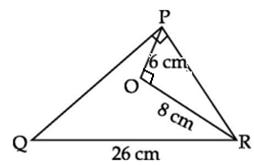
PQR where OP = 6 cm, OR = 8 cm and QR = 26 cm.
Solution
In  POR,
PR2 = PO2 + OR2 (Pythagoras Theorem)
PR2 = 62 + 82
PR2 = 102
POR,
PR2 = PO2 + OR2 (Pythagoras Theorem)
PR2 = 62 + 82
PR2 = 102  PR = 10 cm
In PQR,
QR2 = PQ2 + PR2 (Pythagoras Theorem)
PQ2 = 262 - 102
= 676 - 100
= 576
PR = 10 cm
In PQR,
QR2 = PQ2 + PR2 (Pythagoras Theorem)
PQ2 = 262 - 102
= 676 - 100
= 576
 PQ = 24 cm

POR,
PR2 = PO2 + OR2 (Pythagoras Theorem)
PR2 = 62 + 82
PR2 = 102 PR = 10 cm
In PQR,
QR2 = PQ2 + PR2 (Pythagoras Theorem)
PQ2 = 262 - 102
= 676 - 100
= 576
PQ = 24 cm
Q6.  ABC
ABC  PQR. If area (ABC) = 2.25 m2, area (PQR) = 6.25 m2, PQ = 0.5 m, then length of AB is:
ABC PQR. If area (ABC) = 2.25 m2, area (PQR) = 6.25 m2, PQ = 0.5 m, then length of AB is:Solution

Q7. Perimeters of two similar triangles PQR and MNS are in the ratio 13:15
The sides of Triangle MNP are MN=8, NS=10 MS =12 find the sides of triangle PQR.
Solution
According to question  =
=
 =(corresponding sides of similar triangles are proportional)
 ,
,  ,
, 
 ,
,  ,
,
=
=(corresponding sides of similar triangles are proportional)
, ,
, ,
Q8. In an
equilateral triangle ABC, D is a point on side BC such that  BC. Prove that
9AD2 = 7AB2.
BC. Prove that
9AD2 = 7AB2.
BC. Prove that
9AD2 = 7AB2.Solution
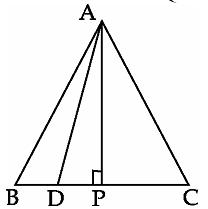 Draw
AP
Draw
AP  BC.
BD
=
BC.
BD
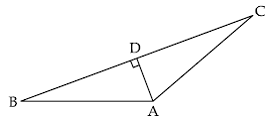
=  Since
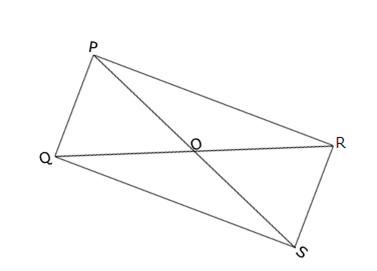
Since
 ABC is equilateral and AP BC,
BP
= PC =
ABC is equilateral and AP BC,
BP
= PC =  BC = AB
Using
Pythagoras theorem in ABP,
AP2
+ BP2 = AB2
AP2
= AB2 - BP2 = AB2 -
BC = AB
Using
Pythagoras theorem in ABP,
AP2
+ BP2 = AB2
AP2
= AB2 - BP2 = AB2 -  =
=  … (1)
Using
Pythagoras theorem in ADP,
AD2
= AP2 + DP2
=
… (1)
Using
Pythagoras theorem in ADP,
AD2
= AP2 + DP2
=  AB2
+ (BP - BD)2
= AB2
+
AB2
+ (BP - BD)2
= AB2
+  =
=  36AD2
= 28AB2
9AD2
= 7AB2
Hence,
proved.
36AD2
= 28AB2
9AD2
= 7AB2
Hence,
proved.
Q9. In the figure, DE || BC, then x is equal to:
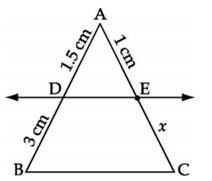
Solution
Since, DE || BC, by Basic proportionality theorem,

Q10. The areas of two similar triangles ABC and PQR are in the ratio 4 : 9. If the sum of the perimeters is 30 m, find the perimeter of each triangle.
Solution
Let x and y, s and t, u and v, be the corresponding sides of the triangles.
Then according to question,
 So
So  = ratio of perimeters of triangles ABC and PQR
Let 2z and 3z be the respective perimeters.
So according to question 2z + 3z = 30
So z = 6
Hence the required perimeters are 12 cm and 18 cm.
= ratio of perimeters of triangles ABC and PQR
Let 2z and 3z be the respective perimeters.
So according to question 2z + 3z = 30
So z = 6
Hence the required perimeters are 12 cm and 18 cm.
So = ratio of perimeters of triangles ABC and PQR
Let 2z and 3z be the respective perimeters.
So according to question 2z + 3z = 30
So z = 6
Hence the required perimeters are 12 cm and 18 cm.
Q11. 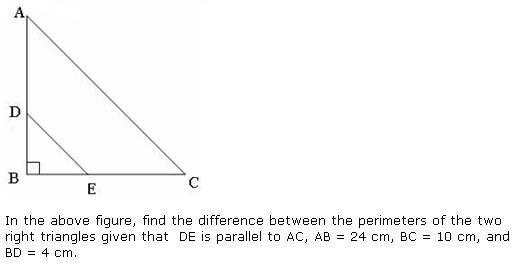
Solution

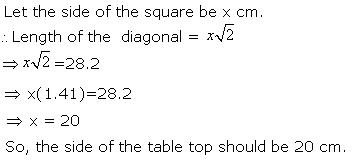
Q12. A carpenter wants to make a stool with a square top. He takes the length of the diagonal as 28.2 cm What should be the length of side of the square?
Solution
Q13. In given figure, DE||BC, if AB = 7.6 cm, AD = 1.9 cm, then AE : EC is :
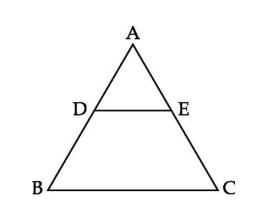
Solution
Since, DE || BC, by Basic Proportionality theorem,
 Thus, AE: EC = 1:3.
Thus, AE: EC = 1:3.
Q14. In figure, O is a point inside  PQR such that
  POR = 90o, OP = 6 cm and OR = 8 cm. If PQ = 24 cm, QR = 26 cm, prove that QPR is a right angled triangle.
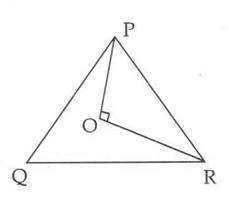
PQR such that POR = 90o, OP = 6 cm and OR = 8 cm. If PQ = 24 cm, QR = 26 cm, prove that QPR is a right angled triangle.
Solution
In POR,
PR2 = PO2 + OR2 = 62 + 82 = 36 + 64 = 100
PR = 10 cm
Now, PQ2 = 242 = 576
QR2 = 262 = 676
So, PQ2 + PR2 = 676 = QR2
By the converse of Pythagoras theorem,
 Hence, QPR is a right angled triangle.
POR,
PR2 = PO2 + OR2 = 62 + 82 = 36 + 64 = 100
PR = 10 cm
Now, PQ2 = 242 = 576
QR2 = 262 = 676
So, PQ2 + PR2 = 676 = QR2
By the converse of Pythagoras theorem,
Hence, QPR is a right angled triangle.
Q15. PQRS
is a trapezium with PQ||SR. Diagonals PR and SQ intersect at M.  PMS
PMS  QMR. Prove that PS = QR.
PMS QMR. Prove that PS = QR.Solution
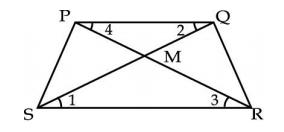 In MSR and MQP,
 1
= 2
3
= 4
(Alternate angles)
1
= 2
3
= 4
(Alternate angles)

 [AA
similarity]
[AA
similarity]
 Also,
Also, 
 From (1) and (2),

 QM2 = PM2
QM = PM
… (3)
From (1), (3),
QM2 = PM2
QM = PM
… (3)
From (1), (3),
 … (4)
From (2), (3), (4), we have:
… (4)
From (2), (3), (4), we have:

Q16. Two
right triangles ABC and DBC are drawn on the same hypotenuses BC and on the
same side of BC. If AC and BD intersect at P, prove that:
AP  PC = BP DP
PC = BP DPSolution
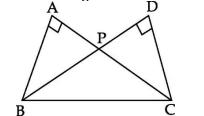 In
In
 BPA and CPD,
 BAP
= CDP = 90o
APB
= DPC (Vertically
opposite angles)
BAP
= CDP = 90o
APB
= DPC (Vertically
opposite angles)
 Hence, proved.
Q17.
An equilateral triangle is based on the side of a square of area 64 sq. cm and another on the diagonal of the same square. Find the ratio of their areas.
Solution
We see that the side of the square = 8 cm
So the diagonal of the square =  cm
Since both are equilateral triangles, so they are equiangular, each of their angles is
cm
Since both are equilateral triangles, so they are equiangular, each of their angles is  .
So the two triangles are similar.
Hence the ratio of their areas = ratio of squares of their corresponding sides.
Let A be the area of the equilateral triangle based on the side 8 cm.
Let A' be the area of the equilateral triangle based on the diagonal
.
So the two triangles are similar.
Hence the ratio of their areas = ratio of squares of their corresponding sides.
Let A be the area of the equilateral triangle based on the side 8 cm.
Let A' be the area of the equilateral triangle based on the diagonal  cm.
cm.

cm
Since both are equilateral triangles, so they are equiangular, each of their angles is .
So the two triangles are similar.
Hence the ratio of their areas = ratio of squares of their corresponding sides.
Let A be the area of the equilateral triangle based on the side 8 cm.
Let A' be the area of the equilateral triangle based on the diagonal cm.
Q18. In figure,  , then y + z is:
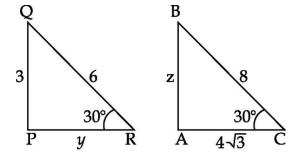
, then y + z is:
-
1)

-
2)

-
3)

-
4)

Solution
Given,

Q19. In a trapezium, show that any line drawn parallel to the parallel sides of the trapezium, divides the non-parallel sides proportionally.
Solution
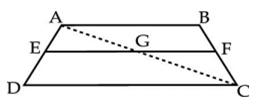 ABCD is a trapezium and EF||AB||CD
Join AC to cut EF at G.
In
ABCD is a trapezium and EF||AB||CD
Join AC to cut EF at G.
In  ADC, EG||DC, so by Basic Proportionality theorem, we have:
 ...(1)
In ACB, GF||AB, so by Basic Proportionality theorem, we have:
...(1)
In ACB, GF||AB, so by Basic Proportionality theorem, we have:
 ...(2)
From (1) and (2), we get
...(2)
From (1) and (2), we get
 Hence proved.
Q20. In the figure given below, if DE || BC, then x equals :
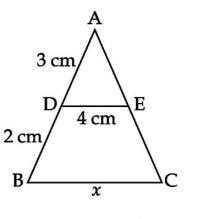
Solution
Since, DE || BC,
 ADE = ABC
AED = ACB
ADE = ABC
AED = ACB
 (by AA similarity)
 Hence, BC = x = 6.7 cm
ADE = ABC
AED = ACB
(by AA similarity)
Hence, BC = x = 6.7 cm
Q21. In the given figure, ABCD is a trapezium in which AB || DC. The diagonals AC and DB intersect at O.
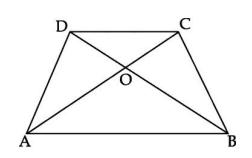 Prove that:
Prove that: Solution
In  AOB and COD, we have:
 AOB = COD(Vertically opposite angles)
OAB = OCD(Alternate interior angles, as AB || CD)
AOB = COD(Vertically opposite angles)
OAB = OCD(Alternate interior angles, as AB || CD)
 AOB
AOB  COD (By AA similarity)

AOB and COD, we have:
AOB = COD(Vertically opposite angles)
OAB = OCD(Alternate interior angles, as AB || CD)
AOB COD (By AA similarity)
Q22. In the
given figure, PQRS is a rhombus such that RQ is produced to E and SE is
joined. SE and PR intersect at D. Prove that SD. RE = SR. DE.
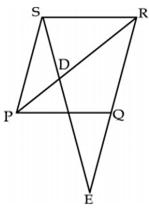
Solution
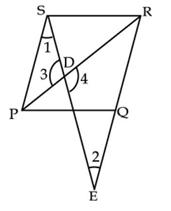 In
In
 PDS and RDE
 1
= 2
[Alternate interior angles]
3
= 4
[Vertically opposite angles]
1
= 2
[Alternate interior angles]
3
= 4
[Vertically opposite angles]
 PDS
PDS  RDE
[AA similarity]
RDE
[AA similarity]



 [
[ PS = SR]
DS. RE = SR. DE
PS = SR]
DS. RE = SR. DE
Q23. In the
given figure,  ABC is an isosceles right angled triangle with
  B = 90o such that PQ
  AC, ST AC, where P
lies on AB and S lies on BC. Then, prove that AQP
AC, ST AC, where P
lies on AB and S lies on BC. Then, prove that AQP  CTS.
CTS.
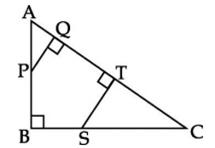
ABC is an isosceles right angled triangle with B = 90o such that PQ AC, ST AC, where P
lies on AB and S lies on BC. Then, prove that AQP CTS.
Solution
Since,
ABC is an isosceles right angled triangle,
AB
= BC
In
AQP and CTS,
QAP
= TCS
[In
a triangle, angles opposite to equal sides are equal]
AQP
= CTS = 90o
 AQP CTS [AA similarity]
Q24. A vertical pole of 10 m casts a shadow of 6 m long on the ground. At the same time, a tree casts a shadow 60 m long on the ground. The height of the tree is
Solution
Let AB be the pole and AC be its shadow.
Let DE be the tree and DF be its shadow. ∆ABC ∼∆DEF… (AA test)
AB/DE=AC/DF
10/6 = AC/60AC = 100 m
Q25. In the given figure  YXZ = XPZ, then
  is equal to:
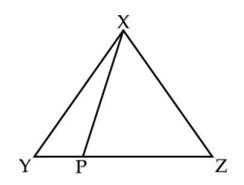
YXZ = XPZ, then is equal to:
-
1)

- 2) PZ2
-
3) ZY
 ZP
ZP
- 4) XZ2
Solution

Q26. In
given figure, is a right triangle PQR, right angled Q. X and Y are the point
on PQ and QR such that PX : XQ = 1:2 and QY : YR = 2:1. Prove that 9 (PY2
+ XR2) = 13PR2.

Solution
X
divides PQ in ratio 1: 2.
 ...(1)
Also,
Y divides QR in ratio 2:1
...(1)
Also,
Y divides QR in ratio 2:1
 ...(2)
In
right
...(2)
In
right  PQY,
PY2
= PQ2 + QY2
PY2
= PQ2 +
PQY,
PY2
= PQ2 + QY2
PY2
= PQ2 +  PY2
= PQ2 +
PY2
= PQ2 +  QR2
9PY2
= 9PQ2 + 4QR2 ...(3)
In
right XQR,
XR2
= XQ2 + QR2
QR2
9PY2
= 9PQ2 + 4QR2 ...(3)
In
right XQR,
XR2
= XQ2 + QR2

 9XR2
= 4PQ2 + 9QR2
...(4)
Adding
(3) and (4), we get,
9PY2
+ 9XR2 = 9PQ2 + 4QR2 + 4 PQ2 +
9QR2
9
(PY2 + XR2) = 13 PQ2 + 13 QR2
9(PY2
+ XR2) = 13 (PQ2 + QR2) = 13 PR2
9XR2
= 4PQ2 + 9QR2
...(4)
Adding
(3) and (4), we get,
9PY2
+ 9XR2 = 9PQ2 + 4QR2 + 4 PQ2 +
9QR2
9
(PY2 + XR2) = 13 PQ2 + 13 QR2
9(PY2
+ XR2) = 13 (PQ2 + QR2) = 13 PR2 
...(1)
Also,
Y divides QR in ratio 2:1
...(2)
In
right PQY,
PY2
= PQ2 + QY2
PY2
= PQ2 +
PY2
= PQ2 + QR2
9PY2
= 9PQ2 + 4QR2 ...(3)
In
right XQR,
XR2
= XQ2 + QR2
9XR2
= 4PQ2 + 9QR2
...(4)
Adding
(3) and (4), we get,
9PY2
+ 9XR2 = 9PQ2 + 4QR2 + 4 PQ2 +
9QR2
9
(PY2 + XR2) = 13 PQ2 + 13 QR2
9(PY2
+ XR2) = 13 (PQ2 + QR2) = 13 PR2
Q27. In figure  BAC = 90°, AD
  BC. Prove that: AB2 + CD2 = BD2 + AC2.
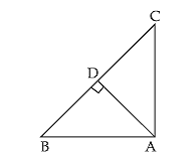
BAC = 90°, AD BC. Prove that: AB2 + CD2 = BD2 + AC2.
Solution
Q28. If LM II CB and LN II CD, prove that


Solution
In  ACB, LM || CB
Therefore, by
ACB, LM || CB
Therefore, by 
 In ADC, NL II DC, hence by BPT
 From (I) and (II)
  Or
Or  (INVERTENDO)


 Or (INVERTENDO)
ACB, LM || CB
Therefore, by
In ADC, NL II DC, hence by BPT
From (I) and (II)
Or (INVERTENDO)
Or (INVERTENDO)
Q29. In
the given figure, AD  BC. Prove that
AB2 + CD2 = BD2 + AC2.
BC. Prove that
AB2 + CD2 = BD2 + AC2.
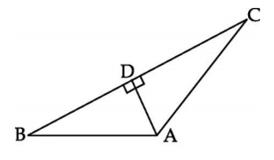
BC. Prove that
AB2 + CD2 = BD2 + AC2.
Solution
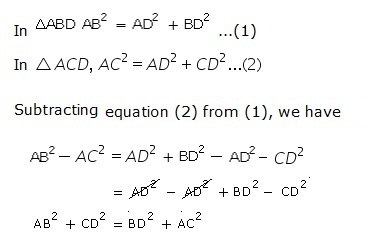
In
 ADB,
AB2
= BD2 + AD2
(Pythagoras theorem)
ADB,
AB2
= BD2 + AD2
(Pythagoras theorem)
 ...(1)
Also
in ADC,
AC2
= CD2 + AD2 (Pythagoras theorem)
...(1)
Also
in ADC,
AC2
= CD2 + AD2 (Pythagoras theorem)
 AD2 = AC2 - CD2 ...(2)
From
(1) and (2), we get,
AB2
- BD2 = AC2 - CD2
AB2 + CD2 = BD2
+ AC2
AD2 = AC2 - CD2 ...(2)
From
(1) and (2), we get,
AB2
- BD2 = AC2 - CD2
AB2 + CD2 = BD2
+ AC2
ADB,
AB2
= BD2 + AD2
(Pythagoras theorem)
...(1)
Also
in ADC,
AC2
= CD2 + AD2 (Pythagoras theorem)
AD2 = AC2 - CD2 ...(2)
From
(1) and (2), we get,
AB2
- BD2 = AC2 - CD2
AB2 + CD2 = BD2
+ AC2
Q30. Triangle ABC is right angled at B and D is mid-point
of BC. Prove that:
AC2 = 4AD2 - 3AB2
Solution
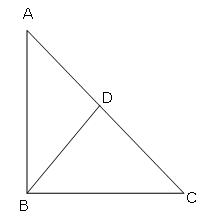 In right
  ABC, using Pythagoras theorem,
AC2 = AB2 + BC2 …(1)
In right ABD, using Pythagoras theorem,
AD2 = AB2 + BD2
AD2 = AB2 +
ABC, using Pythagoras theorem,
AC2 = AB2 + BC2 …(1)
In right ABD, using Pythagoras theorem,
AD2 = AB2 + BD2
AD2 = AB2 + 
 AD2 = AB2 +
 BC2
BC2
 4AD2 = 4AB2 + BC2
BC2
= 4AD2 − 4AB2 …(2)
Substituting (2) in (1), we get
AC2 = AB2 + 4AD2
− 4AB2 = 4AD2
- 3AB2
AC2 = 4AD2 - 3AB2
4AD2 = 4AB2 + BC2
BC2
= 4AD2 − 4AB2 …(2)
Substituting (2) in (1), we get
AC2 = AB2 + 4AD2
− 4AB2 = 4AD2
- 3AB2
AC2 = 4AD2 - 3AB2
Q31. In Figure DE II OQ and DF II OR show that EF II QR.

Solution
In  PQO; DE II OQ
 (BPT)
Also, in POR; DF II OR
(BPT)
Also, in POR; DF II OR
 (BPT)
From (1) and (2) we have
(BPT)
From (1) and (2) we have
 From converse of BPT, we have EF II QR. Hence proved
PQO; DE II OQ
(BPT)
Also, in POR; DF II OR
(BPT)
From (1) and (2) we have
From converse of BPT, we have EF II QR. Hence proved
Q32. ABCD is a trapezium in which AB || DC and its diagonals intersect each other at the point O. Show that

Solution
In Figure ABCD is a trapezium, AB II DC through O draw PQ II AB
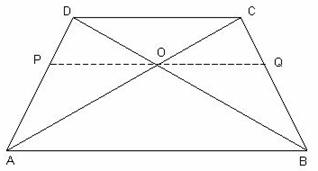 In
In  ADB, PO II AB
 (By BPT)
Or
(By BPT)
Or  Again in ACD, PO II DC (
  AB II DC II PO )
 (By BPT) (2)
From (1) and (2)
(By BPT) (2)
From (1) and (2)
 (by alternando)
Hence proved
(by alternando)
Hence proved
In ADB, PO II AB
(By BPT)
Or
Again in ACD, PO II DC ( AB II DC II PO )
(By BPT) (2)
From (1) and (2)
(by alternando)
Hence proved
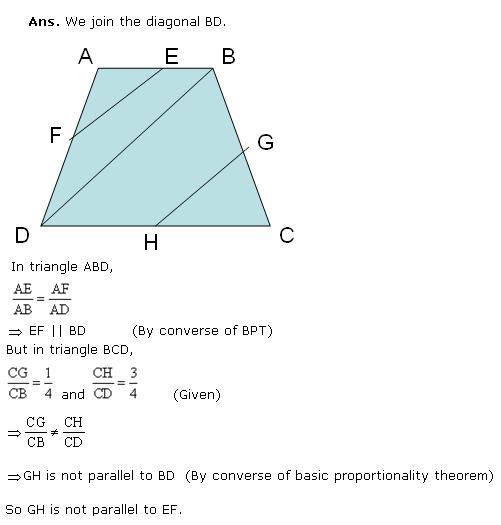
Q33. In a trapezium ABCD, E and F are points on AB and AD respectively. Also G and H are points on CB and CD respectively such that AE=3, AB=9, AF=2, AD=6, CG=1, CB=4, CH=3, CD=4. Check if EF || GH.
Solution
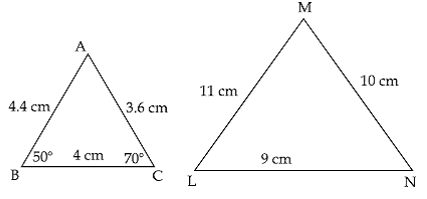
Q34. From the given figure, find 
Solution
From the given figure,
 Therefore,
  ABC is similar to LMN (SSS similarity)

 MLN = BAC = 180
 - (50o + 70o) = 60o
Therefore, ABC is similar to LMN (SSS similarity)
MLN = BAC = 180 - (50o + 70o) = 60o
Q35. In
the given figure,  PQR is right-angled triangle right-angled at Q. DE
  PR. Prove PQR
  PED and find the lengths of PE and DE if PD = 3 cm,
QD = 2 cm and QR = 12 cm.
PED and find the lengths of PE and DE if PD = 3 cm,
QD = 2 cm and QR = 12 cm.
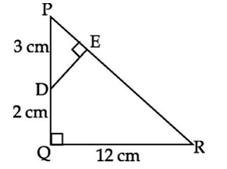
PQR is right-angled triangle right-angled at Q. DE PR. Prove PQR PED and find the lengths of PE and DE if PD = 3 cm,
QD = 2 cm and QR = 12 cm.
Solution
In
right PQR,
PR2
= PQ2 + QR2 = 25 + 144 = 169
 PR = 13 cm
Let
PE = x, then ER = 13 - x
PR = 13 cm
Let
PE = x, then ER = 13 - x
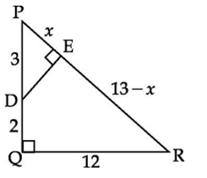 In
PQR and PED,
In
PQR and PED,
 PQR
= PED
QPR
= EPD
PQR PED [AA
similarity]
PQR
= PED
QPR
= EPD
PQR PED [AA
similarity]



PQR,
PR2
= PQ2 + QR2 = 25 + 144 = 169
PR = 13 cm
Let
PE = x, then ER = 13 - x
In
PQR and PED,
PQR
= PED
QPR
= EPD
PQR PED [AA
similarity]
Q36. P and Q are points on sides AB and AC, respectively, of ∆ABC. If AP = 4 cm, PB = 12 cm, AQ = 2 cm and QC = 6 cm, then BC =
Solution
AB = AP + PB = 16 cm
AC = AQ + QC = 8 cm

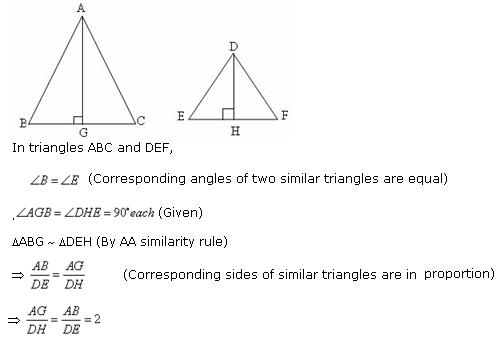
Q37. In two triangles ABC and DEF, BC = EF, AB = DE ,  If AG and DH are the medians of triangles ABC and DEF respectively. Find
  = ?
= ?
If AG and DH are the medians of triangles ABC and DEF respectively. Find = ?Solution
In triangles ABC and DEF,
AB=DE
BC=EF
So  (SAS rule)
Now consider triangles ABG and DEH,
(SAS rule)
Now consider triangles ABG and DEH,

 (as AG and DH are medians)
So BG = EH
AB=DE
Thus we have
(as AG and DH are medians)
So BG = EH
AB=DE
Thus we have 

 (SAS rule)
So
(SAS rule)
So  ( corresponding sides of similar triangles are proportional)
=
( corresponding sides of similar triangles are proportional)
= Hence, =Ratio of the corresponding sides.
=
Hence, =Ratio of the corresponding sides.
=
BC=EF
So (SAS rule)
Now consider triangles ABG and DEH,
(as AG and DH are medians)
So BG = EH
AB=DE
Thus we have (SAS rule)
So ( corresponding sides of similar triangles are proportional)
=
Hence, =Ratio of the corresponding sides.
=
Q38. 
Solution
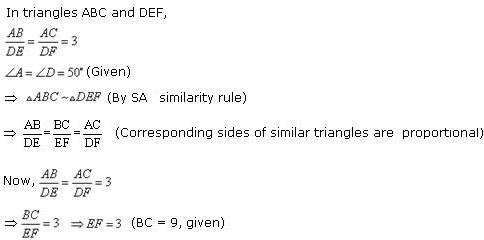
Q39. Which of the following cannot be the sides a right triangle?
- 1) 400 mm, 300 mm, 500 mm
-
2) 2 cm, 1 cm,
 cm
cm
- 3) 9 cm, 5 cm, 7cm
- 4) 9 cm, 15 cm, 12 cm
Solution
9 cm, 5 cm, 7 cm cannot form the sides of a right triangle as the Pythagoras theorem is not satisfied in this case.
Q40. In the given figure,  . Find the value of x.
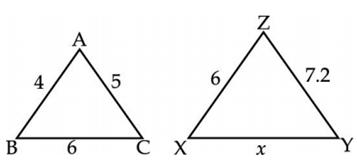
. Find the value of x.
Solution
 ABC
ABC  XYZ
XYZ
 Or
Or 

 x = 4.8
Q41. Three squares are based on the sides of a right angled triangle. The area of the two smaller ones are 144 sq. cm and 256 sq. cm. What is the area of the third one?
Solution
Area of square = (side)2
The smaller sides of the triangle are 12 and 16 cm. respectively
This essentially is the Pythagorean principle, so the hypotenuse =  Largest square"s area will be = 202 = 400 sq.cm
Largest square"s area will be = 202 = 400 sq.cm
Q42. In
given figure, in  ABC, PQ||BC and BC = 3PQ. Find the ratio of the area
of
ABC, PQ||BC and BC = 3PQ. Find the ratio of the area
of  PQR and area of CRB where PC and BQ intersect at R.
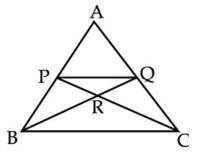
ABC, PQ||BC and BC = 3PQ. Find the ratio of the area
of PQR and area of CRB where PC and BQ intersect at R.
Solution
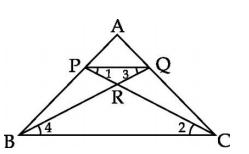 Since PQ||BC,
 1
= 2 [Alternate interior angles]
3
= 4
[Alternate interior angles]
1
= 2 [Alternate interior angles]
3
= 4
[Alternate interior angles]
 PQR
PQR  CBR
[By AA similarity]
CBR
[By AA similarity]
 ar (PQR) : ar(CRB) = 1: 9
Q43. In quadrilateral ABCD,  If AD2 = AB2 + BC2 + CD2. Prove that
If AD2 = AB2 + BC2 + CD2. Prove that Solution
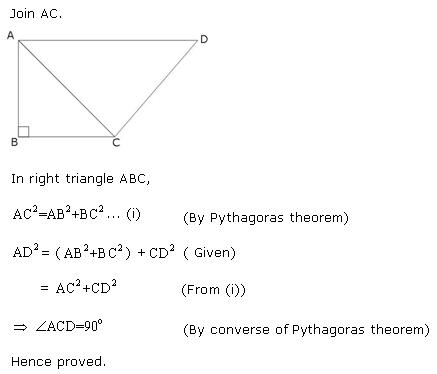
Q44. In figure,  ABC
ABC  PQR, then y + z is
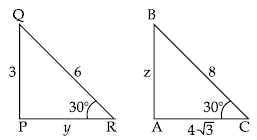
ABC PQR, then y + z is
-
1) 4 + 3

-
2) 2 +
-
3) 4 +
-
4) 3+ 4

Solution
Since triangles ABC and PQR are similar, their corresponding sides are proportional.

Q45. A vertical stick 30 m long casts a shadow 15 m long on the ground. At the same time, a tower casts a shadow 75 m long on the ground. The height of the tower is:
Solution
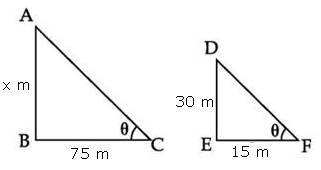 In the figure, DE represents the stick and EF is its shadow; AB represents the tower and BC is its shadow.
 ABC = DEF = 90o
ACB = DFE =
ABC = DEF = 90o
ACB = DFE = 

 Thus, the height of the tower is 150 m.
Q46. In a quadrilateral ABCD, given that  A + D = 90o. Prove that AC2 + BD2 = AD2 + BC2.
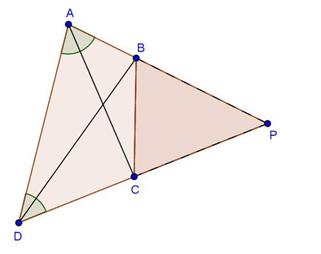
A + D = 90o. Prove that AC2 + BD2 = AD2 + BC2.
Solution
We have, A + D = 90o
In  APD, by angle sum property,
A + D + P = 180o
APD, by angle sum property,
A + D + P = 180o
 90o + P = 180o
P = 180o - 90o = 90o
In APC, by Pythagoras theorem,
AC2 = AP2 + PC2...(1)
In BPD, by Pythagoras theorem,
BD2 = BP2 + DP2...(2)
Adding equations (1) and (2),
AC2 + BD2 = AP2 + PC2 + BP2 + DP2
AC2 + BD2 = (AP2 + DP2) + (PC2 + BP2)
AC2 + BD2 = AD2 + BC2[By Pythagoras theorem]
90o + P = 180o
P = 180o - 90o = 90o
In APC, by Pythagoras theorem,
AC2 = AP2 + PC2...(1)
In BPD, by Pythagoras theorem,
BD2 = BP2 + DP2...(2)
Adding equations (1) and (2),
AC2 + BD2 = AP2 + PC2 + BP2 + DP2
AC2 + BD2 = (AP2 + DP2) + (PC2 + BP2)
AC2 + BD2 = AD2 + BC2[By Pythagoras theorem]
Q47. 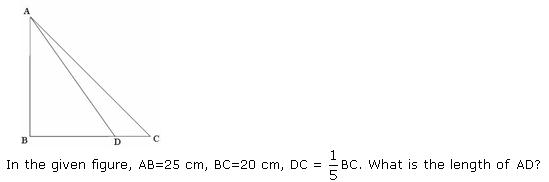
Solution

Q48. In the given figure,  ABC is an isosceles triangle with AB = AC. D is mid-point of BC. If DE
  AB, DF AC, prove that DE = DF.
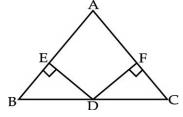
ABC is an isosceles triangle with AB = AC. D is mid-point of BC. If DE AB, DF AC, prove that DE = DF.
Solution
In DEB and DFC,
 E = F = 90o
EBD = FCD [In an isosceles triangle angles opposite to equal sides are equal]
DB = DC [D is mid-point of BC]
Therefore, by Angle-Angle-Side criterion of congruence, the triangles, DEB and DFC are congruent.
E = F = 90o
EBD = FCD [In an isosceles triangle angles opposite to equal sides are equal]
DB = DC [D is mid-point of BC]
Therefore, by Angle-Angle-Side criterion of congruence, the triangles, DEB and DFC are congruent.

 [AAS congruence]
The corresponding parts of the congruent triangles are congruent.
[AAS congruence]
The corresponding parts of the congruent triangles are congruent.
 DE = DF [cpct]
Q49. ABCD is a parallelogram and E,G,H and F are the mid points of the sides AB, BC, CD, DA. Prove that  =
=
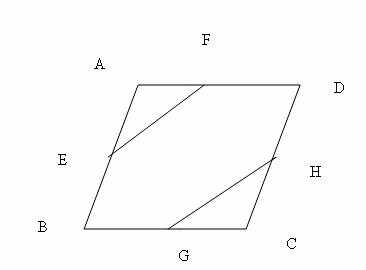
= Solution
We see that AB = CD (opposite sides of a parallelogram are equal)

 Similarly AF = GC
Also
Similarly AF = GC
Also  (opposite angles of a parallelogram are equal)
 (SAS rule)
This is also a special case of similarity where the ratio of corresponding sides is 1:1
(SAS rule)
This is also a special case of similarity where the ratio of corresponding sides is 1:1

 Hence area of triangles AEF and GCH are equal.
Similarly AF = GC
Also (opposite angles of a parallelogram are equal)
(SAS rule)
This is also a special case of similarity where the ratio of corresponding sides is 1:1
Hence area of triangles AEF and GCH are equal.
Q50. In fig. ABD is a triangle in which
ÐDAB = 90° and AC  BD. Prove that AD2 = BD
  CD.
CD.
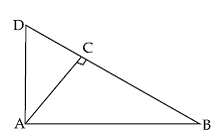
BD. Prove that AD2 = BD CD.
Solution
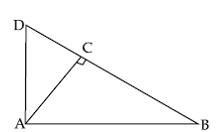 In
In  DCA and DAB
 D is common
DCA = DAB = 90o
Therefore, DCA
D is common
DCA = DAB = 90o
Therefore, DCA  DAB, by AA similarity
Therefore, corresponding sides are proportional.
DAB, by AA similarity
Therefore, corresponding sides are proportional.

 DA2
= DC x DB
DA2
= DC x DB
Q51. In figure,  ABC is right angled at C. DE
  AB. If BC = 12 cm. AD = 3 cm and DC = 2 cm, then prove that
  and hence find the lengths of AE and DE.
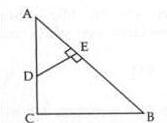
ABC is right angled at C. DE AB. If BC = 12 cm. AD = 3 cm and DC = 2 cm, then prove that and hence find the lengths of AE and DE.
Solution
ABC  ADE (by AAS)
 In right
  AB2 = BC2 + AC2 (by Pythagoras theorem)
 AB2 = 52 + 122 = 25 + 144 = 169
AB = 13
Substituting AB = 13 cm, BC = 12 cm and AC = 5 cm in (1),
DE =
AB2 = 52 + 122 = 25 + 144 = 169
AB = 13
Substituting AB = 13 cm, BC = 12 cm and AC = 5 cm in (1),
DE =  and AE =
Q52. In
given figure, ABCD is a rectangle, in which BC = 2AB. A point E lies on CD
produced such that CE = 2BC. Find AC: BE.
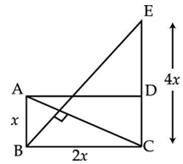
Solution
 In
In
 ABC and BCE,
 and
and
 B = C = 90o

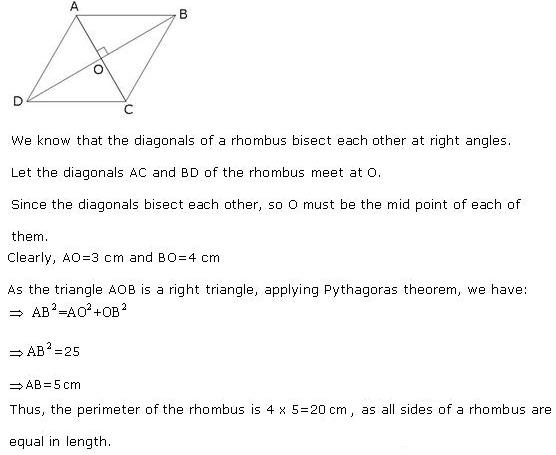
Q53. The diagonals AC and BD of a rhombus ABCD are of length 6 cm and 8 cm respectively. What is the perimeter of the rhombus?
Solution
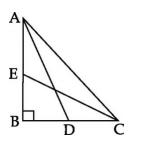
Q54.  ABC
is right angled at B. AD and CE are the two medians drawn from A and C,
respectively. If AC = 5 cm, AD =
ABC
is right angled at B. AD and CE are the two medians drawn from A and C,
respectively. If AC = 5 cm, AD =  cm, find the
length of CE.
cm, find the
length of CE.
ABC
is right angled at B. AD and CE are the two medians drawn from A and C,
respectively. If AC = 5 cm, AD = cm, find the
length of CE.
Solution
By
Pythagoras theorem, we have,
AB2
+ BD2 = AD2
AC2
- BC2 + BD2 = AD2
AC2
- AD2 = BC2 - BD2

Q55. In fig, PA
QB and RC are perpendiculars to AC. Prove that 
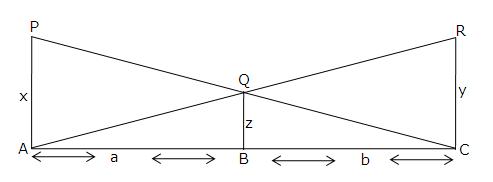
Solution
In 

 ...(1)
Similarly,
...(1)
Similarly,

 ...(2)
From (1) and (2)
...(2)
From (1) and (2)

 xy = xz
+ yz
Dividing by xyz, we get,
xy = xz
+ yz
Dividing by xyz, we get,

...(1)
Similarly,
...(2)
From (1) and (2)
xy = xz
+ yz
Dividing by xyz, we get,
Q56. Find value of x from given figure of DE II BC

Solution



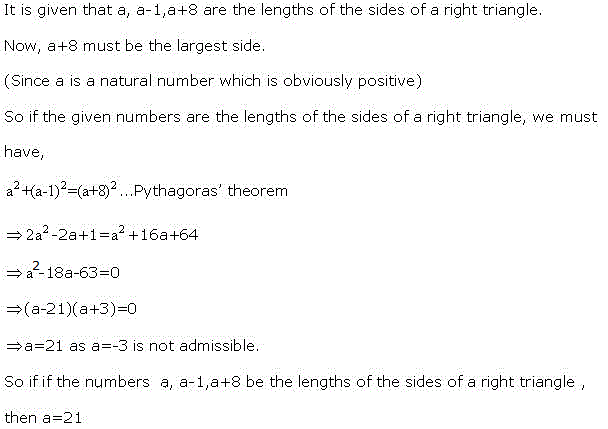
Q57. What is the value of a if a, a-1,a+8 are the lengths of the sides of a right triangle where a is a natural number?
Solution
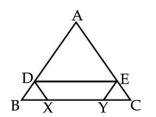
Q58. In
given figure  ABC, X and Y are two points lying on the side BC such
that BX = CY. If DX||AC and YE||AB, then prove that DE||BC.
ABC, X and Y are two points lying on the side BC such
that BX = CY. If DX||AC and YE||AB, then prove that DE||BC.
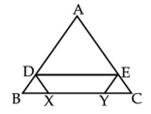
ABC, X and Y are two points lying on the side BC such
that BX = CY. If DX||AC and YE||AB, then prove that DE||BC.
Solution
 BX
= CY (Given)
BX
= CY (Given)
 … (1)
Now
in ABC, DX||AC. Using BPT,
… (1)
Now
in ABC, DX||AC. Using BPT,


 … (2) [Using
(1)]
In
ABC, YE||AB. Using BPT,
… (2) [Using
(1)]
In
ABC, YE||AB. Using BPT,
 …
(3)
From
(2) and (3),
…
(3)
From
(2) and (3),
 DE||BC [ By converse of BPT]
Q59. In the
given figure,  1 = 2 and 3 = 4. Show that AE.BC = AC.DE.
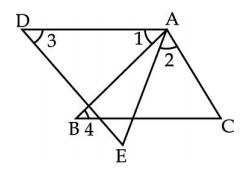
1 = 2 and 3 = 4. Show that AE.BC = AC.DE.
Solution
In
 ADE and ABC,
As,
1 = 2
ADE and ABC,
As,
1 = 2
 Or
DAE = BAC
And
3 = 4
Or
DAE = BAC
And
3 = 4

 or
AE.BC = AC.DE
or
AE.BC = AC.DE
Q60. In
given figure, in  ABC, DE||BC such that ar (ADE) = ar (BCED). Then, prove that
  .
.
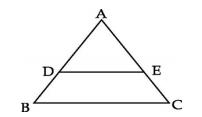
ABC, DE||BC such that ar (ADE) = ar (BCED). Then, prove that .
Solution
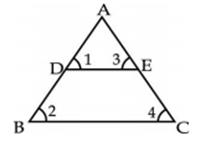 Since,
DE||BC
So,
Since,
DE||BC
So,
 1 = 2
[Corresponding angles]
3 = 4
[Corresponding angles]
1 = 2
[Corresponding angles]
3 = 4
[Corresponding angles]
 [AA similarity]
 … (1)
Also,
given that ar(ADE) = ar(BCED)
… (1)
Also,
given that ar(ADE) = ar(BCED)
 ar(ADE) = ar(ABC) - ar(ADE)
2ar (ADE) = ar(ABC)
ar(ADE) = ar(ABC) - ar(ADE)
2ar (ADE) = ar(ABC)
 … (2)
From
(1) and (2), we have:
… (2)
From
(1) and (2), we have:

 Hence,
proved.
Hence,
proved.
Q61. Two triangles ABC and PQR are such that  and
and  . If the ratio of their perimeters is 3 : 5, Find the ratio of their areas.
and . If the ratio of their perimeters is 3 : 5, Find the ratio of their areas.Solution
From the given information,
We see that (AA rule)
So,
(AA rule)
So, 
 So according to question ,

 ( ratio of their areas is the same as the ratio of the squares of their corresponding sides.)
(AA rule)
So,
So according to question ,
( ratio of their areas is the same as the ratio of the squares of their corresponding sides.)
Q62. The length of an altitude of an equilateral triangle of side a is:
-
1)

-
2)

-
3)

-
4)

Solution
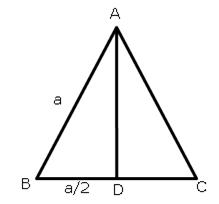 ABC is the equilateral triangle. Let AD be the altitude.
Using Pythagoras theorem in
ABC is the equilateral triangle. Let AD be the altitude.
Using Pythagoras theorem in  ABC, we have:
AD2 = AB2 - BD2
ABC, we have:
AD2 = AB2 - BD2
 Hence, AD =
Q63. In
the given figure, if  and
and  PQR = PRQ. Prove that
  PQS
PQS  TQR.
TQR.
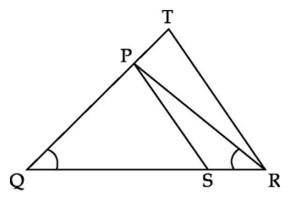
and PQR = PRQ. Prove that PQS TQR.
Solution
Given
:  ...(1)

 PQ = PR
From
(1),
PQ = PR
From
(1),
 In
In
 PQS and TQR,
 Q
is common and
Q
is common and  By SAS similarity criterion,
PQS TQR
By SAS similarity criterion,
PQS TQR
...(1)
PQ = PR
From
(1),
In
PQS and TQR,
Q
is common and
By SAS similarity criterion,
PQS TQR
Q64. There is a triangular park ABC in a colony (see figure). The resident Welfare Association of the colony wishes to divide this park intwo two parts - one for planting trees and raising a lawn and the other for providing place for children to play. They decided to divide the park by creating a boundary along XY which is parallel to AC (as shown in fgure) such that ar( BXY) = 2ar(ACYX). State how this boundary XY can be drawn so that X and Y lie on AB and BC respectively.
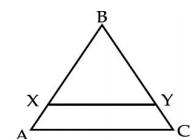
BXY) = 2ar(ACYX). State how this boundary XY can be drawn so that X and Y lie on AB and BC respectively.
Solution
ar (BXY) = 2 ar(ACYX)
ar (BXY) = 2 [ar (BAC) - ar (BXY)]
3 ar(BXY) = 2 ar(BAC)
 ...(1)
In BXY and BAC,
...(1)
In BXY and BAC,
 B = B (Common)
BXY = BAC (Corresponding angles)
B = B (Common)
BXY = BAC (Corresponding angles)
 BXY
BXY  BAC [AA similarity]


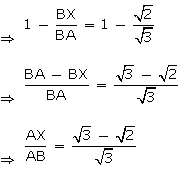
Q65. In
the given figure, AC  BD and CE AD. Prove that
AC2 = DA. AE.
BD and CE AD. Prove that
AC2 = DA. AE.
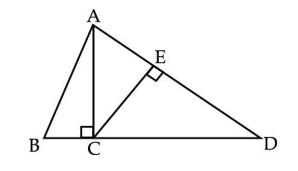
BD and CE AD. Prove that
AC2 = DA. AE.
Solution
In
 ACD and AEC,
 ACD = AEC = 90o
CAD
= EAC
[common]
ACD = AEC = 90o
CAD
= EAC
[common]
 ACD
ACD  AEC
[AA similarity]
AEC
[AA similarity]

 AC2 = AE.AD
ACD and AEC,
ACD = AEC = 90o
CAD
= EAC
[common]
ACD AEC
[AA similarity]
AC2 = AE.AD
Q66. X and
Y are points on the sides PQ and PR respectively of a  PQR.
If the length of PX, QX, PY and YR (in centimeters) are 4, 4.5, 8 and 9
respectively. Then show XY||QR
PQR.
If the length of PX, QX, PY and YR (in centimeters) are 4, 4.5, 8 and 9
respectively. Then show XY||QR
PQR.
If the length of PX, QX, PY and YR (in centimeters) are 4, 4.5, 8 and 9
respectively. Then show XY||QRSolution
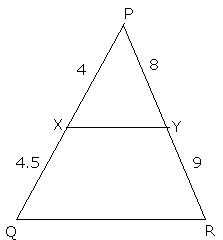

 In PQR,
 XY||QR [By converse of BPT]
Q67. In fig. if  A = B and AD =
BE show that DE || AB in
A = B and AD =
BE show that DE || AB in  ABC
ABC
A = B and AD =
BE show that DE || AB in ABC
Solution
Since A = B, AC = BC
Also AD = BE (Given)
 DC = EC

 DE || AB (By
converse of BPT)
DE || AB (By
converse of BPT)
A = B, AC = BC
Also AD = BE (Given)
DC = EC
DE || AB (By
converse of BPT)
Q68. 
Solution
Q69. 
Solution

Q70. In
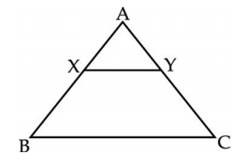
given figure XY||BC, the lengths of AX,AY,XY and BC in centimeters are 2.4,
3.2, 2 and 5 respectively. Find XB and YC.
Solution
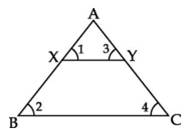 XY||BC
 1 = 2
3 = 4
[corresponding
angles]
1 = 2
3 = 4
[corresponding
angles]
 AXY
AXY  ABC [AA
similarity]
ABC [AA
similarity]

 AB = 6 cm and AC = 8 cm
BX = AB - AX = 6 - 2.4 = 3.6 cm
CY
= AC - AY = 8 - 3.2 = 4.8 cm
AB = 6 cm and AC = 8 cm
BX = AB - AX = 6 - 2.4 = 3.6 cm
CY
= AC - AY = 8 - 3.2 = 4.8 cm
Q71. 
Solution
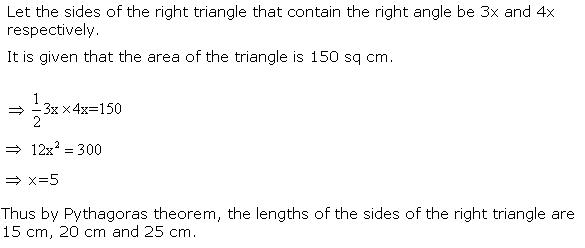
Q72. The sides of a right triangle that contain the right angle are in the ratio 3:4. If the area of the triangle is given to be 150 sq.cm. Find the sides.
Solution
Q73. Triangle
ABC is right angled at B and D is mid point of BC. Prove that :
AC2
= 4AD2 - 3AB2.
Solution
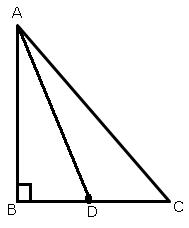 In
right
In
right  ABC, using Pythagoras theorem, we have:
AC2
= AB2 + BC2 ...(1)
In
right ABD, using Pythagoras theorem, we have:
AD2
= AB2 + BD2
ABC, using Pythagoras theorem, we have:
AC2
= AB2 + BC2 ...(1)
In
right ABD, using Pythagoras theorem, we have:
AD2
= AB2 + BD2
 BC2
= 4AD2 - 4AB2 ...(2)
Substituting
(2) in (1), we get,
AC2
= 4AD2 - 3AB2
Hence,
proved.
BC2
= 4AD2 - 4AB2 ...(2)
Substituting
(2) in (1), we get,
AC2
= 4AD2 - 3AB2
Hence,
proved.
Q74. 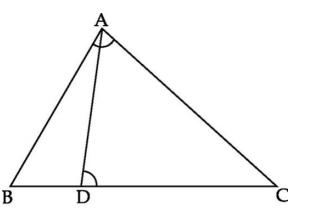 In
the figure, D is a point on the side BC of
In
the figure, D is a point on the side BC of  ABC such that
  BAC = ADC. Prove that CA2 = CB
  CD.
CD.
In
the figure, D is a point on the side BC of ABC such that BAC = ADC. Prove that CA2 = CB CD.Solution
In
ADC and ABC,
C
is common
ADC
= BAC
(Given)
By
AA similarity,
ADC  BAC
BAC
 Or,
AC2 = BC DC
Or,
AC2 = BC DC
ADC and ABC,
C
is common
ADC
= BAC
(Given)
By
AA similarity,
ADC BAC
Or,
AC2 = BC DC
Q75. In figure below, QA and PB are perpendicular to AB. If AO = 10 cm, BO = 6 cm and PB = 9 cm and then find AQ.
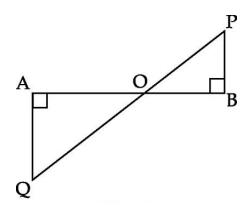
Solution
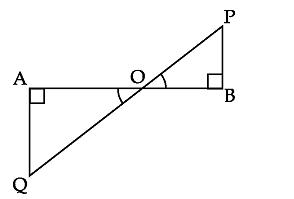
 AOQ = POB(vertically opposite angles)
QAO = PBO (Each 90o)
By AA similarity criterion,
AOQ = POB(vertically opposite angles)
QAO = PBO (Each 90o)
By AA similarity criterion,
 Given AO = 10 cm, BO = 6 cm, PB = 9 cm
 AQ = 15 cm
Q76. If one diagonal of a trapezium divides the other diagonal in the ratio 1: 2. Prove that one of the parallel sides is double the other.
Solution
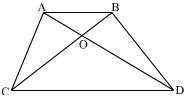 Given: ABCD is a trapezium. AB||CD. Diagonal BC divides the diagonal AD in the ratio 1: 2 at O. That is, OA: OD = 1: 2.
To prove: CD = 2 AB
Proof: In
Given: ABCD is a trapezium. AB||CD. Diagonal BC divides the diagonal AD in the ratio 1: 2 at O. That is, OA: OD = 1: 2.
To prove: CD = 2 AB
Proof: In  AOB and COD,
 AOB = COD (Vertically opposite angles)
ABO = OCD (Alternate angles)
AOB = COD (Vertically opposite angles)
ABO = OCD (Alternate angles)
 Hence, proved.
Q77. In
 PQR, PD
  QR such that D
lies on QR. If PQ = a, PR = b, QD = c and DR = d and a, b, c, d are positive
units, prove that (a + b) (a - b) = (c + d) (c - d).
QR such that D
lies on QR. If PQ = a, PR = b, QD = c and DR = d and a, b, c, d are positive
units, prove that (a + b) (a - b) = (c + d) (c - d).
PQR, PD QR such that D
lies on QR. If PQ = a, PR = b, QD = c and DR = d and a, b, c, d are positive
units, prove that (a + b) (a - b) = (c + d) (c - d).Solution
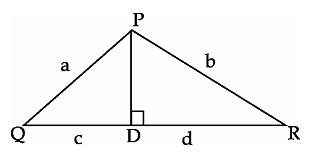 In
PQD,
In
PQD,  PDQ = 90o
Using
Pythagoras theorem,
PD2
= a2 - c2
...(1)
Similarly,
in PDR, PDR = 90o
PD2
= b2 - d2 ...(2)
From
(1) and (2),
a2
- c2 = b2 - d2
PDQ = 90o
Using
Pythagoras theorem,
PD2
= a2 - c2
...(1)
Similarly,
in PDR, PDR = 90o
PD2
= b2 - d2 ...(2)
From
(1) and (2),
a2
- c2 = b2 - d2
 a2 - b2 = c2
- d2
a2 - b2 = c2
- d2
 (a + b) (a - b) = (c + d) (c - d)
Q78. In the given figure,  T and B are right angles. If the lengths of AT, BC and AS (in centimeters) are 15, 16 and 17 respectively, then the length of TC (in centimeters) is:
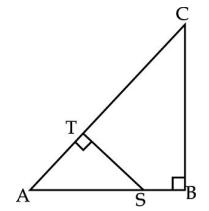
T and B are right angles. If the lengths of AT, BC and AS (in centimeters) are 15, 16 and 17 respectively, then the length of TC (in centimeters) is:
Solution
Using Pythagoras theorem in  ,
TS =
,
TS = 

,
TS =
Q79. The areas of two similar triangles are 49 cm2 and 64 cm2 respectively. If the difference of the corresponding altitudes is 10 cm, then find the length of altitudes (in centimetres).
Solution
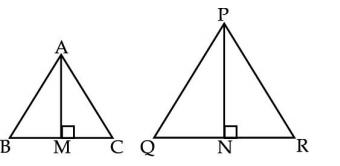 Given,
  ABC
ABC  PQR
PQR
 ... (1)
According to the question,
ar(ABC) = 49 cm2, ar(PQR) = 64 cm2
Let AM = x, then PN = 10 + x
In ABM and PQN,
... (1)
According to the question,
ar(ABC) = 49 cm2, ar(PQR) = 64 cm2
Let AM = x, then PN = 10 + x
In ABM and PQN,
 B = Q
M = N = 90o
B = Q
M = N = 90o
 [AA similarity]
 Or
Or  ... (2)
From (1) and (2),
... (2)
From (1) and (2),


Q80. Two
poles of height p and q metres are standing vertically on a level ground, a
metres apart. Prove that the height of the point of intersection of the lines
joining the top of each pole to the foot of the opposite pole is given by  metres.
metres.Solution
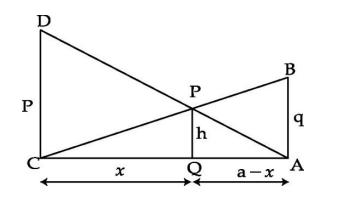 CD
and AB are the two poles of height p and q respectively.
Let
AQ = x, so AQ = a - x (Since,
CA = a, given)
In
CD
and AB are the two poles of height p and q respectively.
Let
AQ = x, so AQ = a - x (Since,
CA = a, given)
In  CQP and CAB,
 C
= C
CQP
= CAB = 90o
C
= C
CQP
= CAB = 90o

 Adding
(1) and (2),
Adding
(1) and (2),

Q81. If AD and PM are medians of  ABC and PQR
respectively where ABC
ABC and PQR
respectively where ABC  PQR. Prove that
ABC and PQR
respectively where ABC PQR. Prove that Solution


 (Since, AD and PM are
medians)
In
(Since, AD and PM are
medians)
In 




Q82. A
pole of length 10 m casts a shadow 2 m long on the ground. At the same time a
tower casts a shadow of length 50 m on the ground. Find the height of the
tower.
Solution
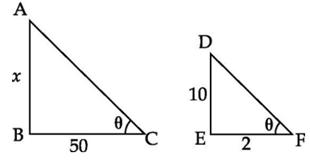 In
the figure, DE represents the pole and EF is its shadow; AB represents the
tower and BC is its shadow.
In
the figure, DE represents the pole and EF is its shadow; AB represents the
tower and BC is its shadow.
 ABC
= DEF = 90o
ACB
= DFE =
ABC
= DEF = 90o
ACB
= DFE = 

Q83. In  ABC, D and E the points on the sides AB and AC
respectively such that DE||BC. If AD = 6x - 7, DB = 4x - 3, AE = 3x - 3 and
EC = 2x - 1, then find the value of x.
ABC, D and E the points on the sides AB and AC
respectively such that DE||BC. If AD = 6x - 7, DB = 4x - 3, AE = 3x - 3 and
EC = 2x - 1, then find the value of x.
ABC, D and E the points on the sides AB and AC
respectively such that DE||BC. If AD = 6x - 7, DB = 4x - 3, AE = 3x - 3 and
EC = 2x - 1, then find the value of x.Solution
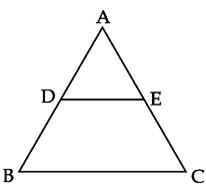 AD
= 6x - 7, DB = 4x - 3
AE
= 3x - 3, EC = 2x - 1
AD
= 6x - 7, DB = 4x - 3
AE
= 3x - 3, EC = 2x - 1
 DE||BC
By
B.P.T
DE||BC
By
B.P.T


Q84. In the figure given below, ABC and DBC are two triangles on the
same base BC. If AD intersect BC at O then show that :
 .
.
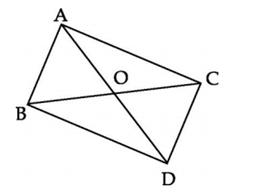
.
Solution
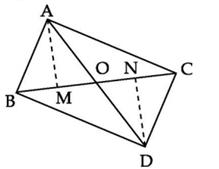 Construction:
Draw AM
Construction:
Draw AM  BC and DN BC
 Now, in
  AMO and
DNO, we have
AMO and
DNO, we have
 AOM
= DON (Vertically opposite angles)
AMO
= DNO = 90o (By
construction)
AOM
= DON (Vertically opposite angles)
AMO
= DNO = 90o (By
construction)
 AMO
AMO
 DNO (By
AA similarity)
DNO (By
AA similarity)


Q85. P
and Q are points on sides AB and AC respectively of  ABC. If AP = 3 cm, PB = 6 cm, AQ = 5 cm and QC = 10
cm, show that BC = 3PQ.
ABC. If AP = 3 cm, PB = 6 cm, AQ = 5 cm and QC = 10
cm, show that BC = 3PQ.
ABC. If AP = 3 cm, PB = 6 cm, AQ = 5 cm and QC = 10
cm, show that BC = 3PQ.Solution
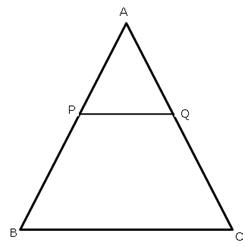 Given, AP = 3 cm and PB = 6 cm
  AB = 9 cm

 Also, given AQ = 5 cm and QC = 10 cm AC = 15 cm




Q86. In
given figure, in  ABC; D, E and F are points on AB, BC and AC
respectively such that ADEF is a parallelogram, then prove that
ABC; D, E and F are points on AB, BC and AC
respectively such that ADEF is a parallelogram, then prove that
 .
.
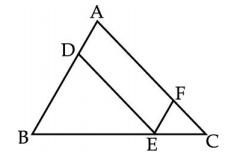
ABC; D, E and F are points on AB, BC and AC
respectively such that ADEF is a parallelogram, then prove that
.
Solution
ADEF
is a ||gm  AD||EF and
AF||DE
AB||BF and
AC||DE
Using
Basic Proportionality theorem,
In
ABC, AB||EF
AD||EF and
AF||DE
AB||BF and
AC||DE
Using
Basic Proportionality theorem,
In
ABC, AB||EF  ...(1)
Also,
AC||DE
...(1)
Also,
AC||DE  ...(2)
From
(1) and (2),
...(2)
From
(1) and (2),
 Hence
proved.
Hence
proved.
Q87. 
Solution
Q88. If the
areas of two similar triangles are equal, prove that they are congruent.
Solution
Given, ar( ABC) = ar(PQR) and
  We know that:
 1 =
1 = 
 AB = PQ
Similarly BC = QR and AC = PR
Thus, ABC
AB = PQ
Similarly BC = QR and AC = PR
Thus, ABC  PQR (SSS congruency criterion)
ABC) = ar(PQR) and
We know that:
1 =
AB = PQ
Similarly BC = QR and AC = PR
Thus, ABC PQR (SSS congruency criterion)
Q89. In  PQR, PD
  QR such that D
lies on QR. If PQ = a, PR = b, QD = c and DR = d, where a, b, c, d are
positive units. Prove that (a + b) (a - b)=(c + d)(c - d)
QR such that D
lies on QR. If PQ = a, PR = b, QD = c and DR = d, where a, b, c, d are
positive units. Prove that (a + b) (a - b)=(c + d)(c - d)
PQR, PD QR such that D
lies on QR. If PQ = a, PR = b, QD = c and DR = d, where a, b, c, d are
positive units. Prove that (a + b) (a - b)=(c + d)(c - d)Solution
In PQD, 
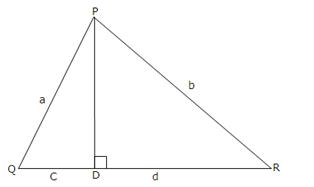 Using Pythagoras theorem.
PD2 = a2 - c2
…(1)
Similarly in
Using Pythagoras theorem.
PD2 = a2 - c2
…(1)
Similarly in  PD2 = b2 - d2
…(2)
From (1) and (2), we get,
a2 - c2 = b2 -
d2
PD2 = b2 - d2
…(2)
From (1) and (2), we get,
a2 - c2 = b2 -
d2
 a2
- b2 = c2 - d2
a2
- b2 = c2 - d2
 (a + b)
(a - b) = (c + d) (c - d)
(a + b)
(a - b) = (c + d) (c - d)
PQD,
Using Pythagoras theorem.
PD2 = a2 - c2
…(1)
Similarly in
PD2 = b2 - d2
…(2)
From (1) and (2), we get,
a2 - c2 = b2 -
d2
a2
- b2 = c2 - d2
(a + b)
(a - b) = (c + d) (c - d)
Q90. 
Solution
Q91. ABCD
is a trapezium in which AB || DC and its diagonals intersect each other at O.
Prove that .
.
.Solution
Draw
OE parallel to AB and CD.
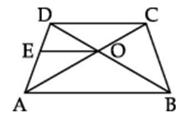 In
In
 ABD, OE || AB
By
Basic Proportionality theorem,
ABD, OE || AB
By
Basic Proportionality theorem,
 ... (i)
In
CDA, OE || CD
By
Basic Proportionality theorem,
... (i)
In
CDA, OE || CD
By
Basic Proportionality theorem,
 ... (ii)
From
(i) and (ii), we get,
... (ii)
From
(i) and (ii), we get,
 Or,
Or,
In
ABD, OE || AB
By
Basic Proportionality theorem,
... (i)
In
CDA, OE || CD
By
Basic Proportionality theorem,
... (ii)
From
(i) and (ii), we get,
Or,
Q92. If two
scalene triangles are equiangular, prove that the ratio of the corresponding
sides is same as the ratio of the corresponding angle bisector segments.
Solution
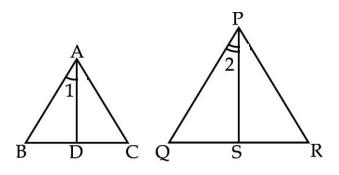 Let
AD be the bisector of
Let
AD be the bisector of  A and PS be the bisector of P.
In
A and PS be the bisector of P.
In
 ABC and PQR,
A
= P, B = Q, C = R (Given)
ABC and PQR,
A
= P, B = Q, C = R (Given)
 Also,
Also,
 In
ABD and PQS,
1
= 2
B
= Q
In
ABD and PQS,
1
= 2
B
= Q
 From
(1) and (2),
From
(1) and (2),
 Hence,
the ratio of the corresponding sides is same as the ratio of the
corresponding angle bisector segments.
Hence,
the ratio of the corresponding sides is same as the ratio of the
corresponding angle bisector segments.
Q93. In the
given figure, ABC is an isosceles triangle with AB = AC. D and E are points
on AB and AC respectively such that AD = AE. Show that  C + EDB = 180o.
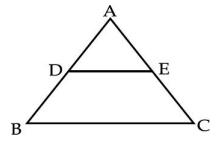
C + EDB = 180o.
Solution
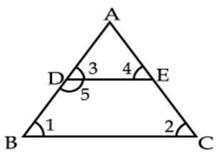 In
In
 ABC and ADE,


 (SAS congruence criterion)
 Hence,
C + EDB = 180o.
Hence,
C + EDB = 180o.
Q94. 
Solution
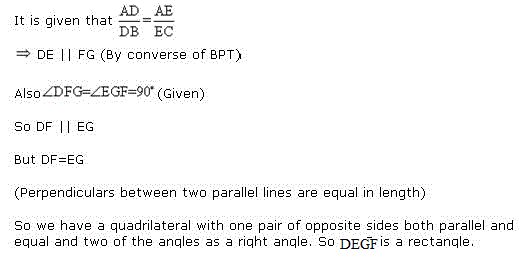
Q95. In figure, DE||OQ and DF||OR. Show that EF||QR.
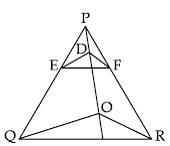
Solution
In  PQO,
PQO,  (BPT)
In POR,
(BPT)
In POR,  (BPT)
Therefore,
(BPT)
Therefore,  By converse of BPT, in
  PQR, we get,
EF||QR
PQR, we get,
EF||QR
PQO, (BPT)
In POR, (BPT)
Therefore,
By converse of BPT, in PQR, we get,
EF||QR
Q96. 
Solution
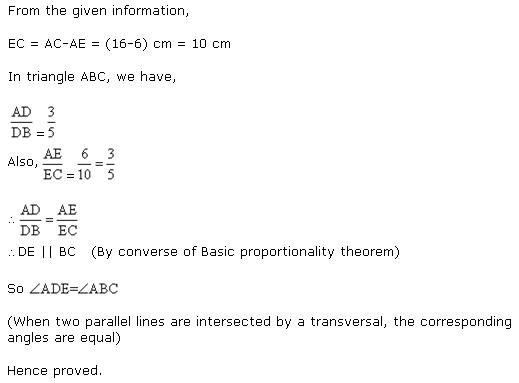
Q97. 
Solution
Q98. ∆ABC and ∆XYZ are similar, and if AB =11 cm, XY= 7 cm and BC = 22 cm, then YZ =
Solution
If two triangles are similar, then their corresponding sides are proportional.

Q99. In figure if AD  BC, then prove that AB2 + CD2 =AC2+ BD2
BC, then prove that AB2 + CD2 =AC2+ BD2
Solution
We will apply Pythagoras theorem.
In  ADC, AD2 = AC2 - CD2
In ABD, AD2 = AB2 - DB2
Therefore, AB2 - DB2 = AC2 - CD2
or AB2 + CD2 = AC2 + DB2
ADC, AD2 = AC2 - CD2
In ABD, AD2 = AB2 - DB2
Therefore, AB2 - DB2 = AC2 - CD2
or AB2 + CD2 = AC2 + DB2
ADC, AD2 = AC2 - CD2
In ABD, AD2 = AB2 - DB2
Therefore, AB2 - DB2 = AC2 - CD2
or AB2 + CD2 = AC2 + DB2
Q100. In fig. PQR
and SQR are two triangles on the same base QR. If PS intersect QR at O, then
show that 
Solution
Construction :- Draw PA  QR and
SB QR
QR and
SB QR
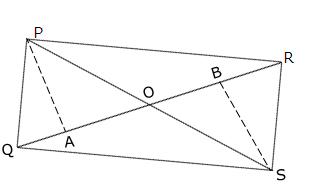

 From (1) and (2),

QR and
SB QR
From (1) and (2),
Q101. In
figure,  ACB = 90o and CD
  AB. Prove that
  .
.
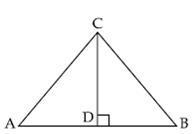
ACB = 90o and CD AB. Prove that .
Solution
In  ACD and ABC,
ADC
= ACB = 90o
DAC
= BAC (Common)
ACD and ABC,
ADC
= ACB = 90o
DAC
= BAC (Common)
 Similarly,
 BC2 = BD
  AB
Therefore,
AB
Therefore, 
ACD and ABC,
ADC
= ACB = 90o
DAC
= BAC (Common)
Similarly,
BC2 = BD AB
Therefore,
Q102. Triangle ABC is an isosceles right triangle right-angled at B. An equilateral triangle ADC based on the hypotenuse and another equilateral triangle BEC are to be compared for their areas. Find the ratio of those two areas.
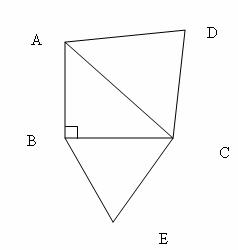
Solution
We know that the area of an equilateral triangle whose side is a is equal to  Now we are given that ABC is a right angled triangle with BC as the hypotenuse.
As it is isosceles, we assume the sides AB= BC to be x cm then the hypotenuse AC =
Now we are given that ABC is a right angled triangle with BC as the hypotenuse.
As it is isosceles, we assume the sides AB= BC to be x cm then the hypotenuse AC = From the above information we see that
  And
And  So,
So,  =
= =2
=2
Now we are given that ABC is a right angled triangle with BC as the hypotenuse.
As it is isosceles, we assume the sides AB= BC to be x cm then the hypotenuse AC =
From the above information we see that
And
So, ==2
Q103. Prove
that the equilateral triangles described on the two sides of a right-angled
triangle are together equal to the equilateral triangle described on the
hypotenuse in terms of their areas.
Solution
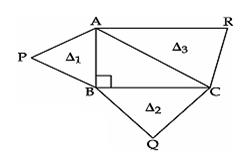 To
prove:
To
prove: 

Q104. In the
given figure, ST and UV are intersecting at O such that the lengths of OS,
OT, OU and OV (in centimeters) are 4.2, 6.3, 1.2 and 1.8. Prove SU||VT.
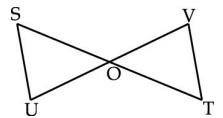
Solution
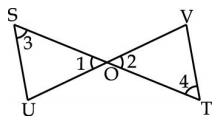 OS
= 4.2 cm, OT = 6.3 cm, OU = 1.2 cm, OV = 1.8 cm
OS
= 4.2 cm, OT = 6.3 cm, OU = 1.2 cm, OV = 1.8 cm
 Also,
Also,
 In
In
 SOU and TOV,
 and
and
 1 = 2 [Vertically
opposite angles]
1 = 2 [Vertically
opposite angles]
 SOU
SOU  TOV [SAS similarity]
 But
they form alternate interior angles when SU and VT are cut by transversal ST.
But
they form alternate interior angles when SU and VT are cut by transversal ST.

Q105. If a line is drawn parallel to one side of a triangle to intersect the other two sides in distinct points, the other two sides are divided in the same ratio. Prove it.
Solution
Given: ΔPQR, in which XY || QR, XY intersects PQ and PR at X and Y respectively.
To prove: Construction: Join RX and QY and draw YN perpendicular to PQ and XM perpendicular to PR.
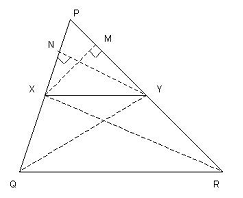 Proof:
Since, Area of a triangle =
Proof:
Since, Area of a triangle =  Therefore, ar (ΔPXY) =
  …(1)
Also, ar (ΔPXY) =
…(1)
Also, ar (ΔPXY) =  …(2)
Similarly, ar (ΔQXY) =
…(2)
Similarly, ar (ΔQXY) =  …(3)
And, ar (ΔRXY) =
…(3)
And, ar (ΔRXY) =  …(4)
Dividing (1) by (3), we get
…(4)
Dividing (1) by (3), we get
 Again, dividing (2) by (4), we get
 Since the area of triangles with same base and between same parallel lines are equal, so
 (as
(as  and
and  are on same base XY and between same parallel lines XY and QR)
Therefore, from (5), (6) and (7), we get
Hence, proved.
are on same base XY and between same parallel lines XY and QR)
Therefore, from (5), (6) and (7), we get
Hence, proved.
Construction: Join RX and QY and draw YN perpendicular to PQ and XM perpendicular to PR.
Proof:
Since, Area of a triangle =
Therefore, ar (ΔPXY) = …(1)
Also, ar (ΔPXY) = …(2)
Similarly, ar (ΔQXY) = …(3)
And, ar (ΔRXY) = …(4)
Dividing (1) by (3), we get
Again, dividing (2) by (4), we get
Since the area of triangles with same base and between same parallel lines are equal, so
(as and are on same base XY and between same parallel lines XY and QR)
Therefore, from (5), (6) and (7), we get
Hence, proved.
Q106. In
fig., (a) and (b) sides AB, BC and median AD of  ABC are respectively proportional to sides PQ, QR and
median PM of PQR. Prove that ABC
ABC are respectively proportional to sides PQ, QR and
median PM of PQR. Prove that ABC  PQR.
PQR.
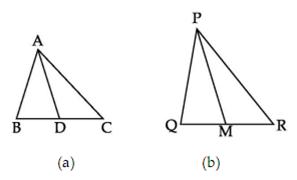
ABC are respectively proportional to sides PQ, QR and
median PM of PQR. Prove that ABC PQR.
Solution
Given:
 Since,
D and M are mid points of BC, QR respectively.
Since,
D and M are mid points of BC, QR respectively.

 In
In
 ABC and PQR, we have,


Since,
D and M are mid points of BC, QR respectively.
In
ABC and PQR, we have,
Q107. In figure, XN || CA and XM || BA. T is a point on CB produced. Prove the TX2 = TB.TC.
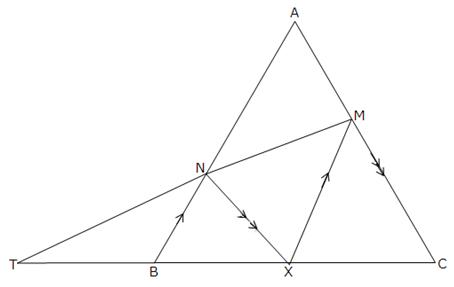
Solution
In  TXM, BN || XM
 …(1)
In TCM, XN || CM
…(1)
In TCM, XN || CM
 From (1) and (2) we get


TXM, BN || XM
…(1)
In TCM, XN || CM
From (1) and (2) we get
Q108. Given triangle ABC with BE and DC as perpendiculars to AC and AB respectively. Prove that  .
.
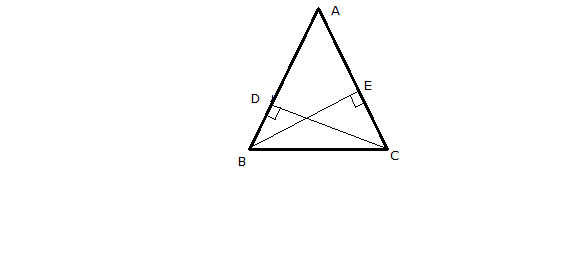
.
Solution
In triangles ABE and ACD,  (each is
  )
)
 is common
So
is common
So  (AA rule)
Hence (corresponding sides of similar triangles are proportional)
Hence proved.
(AA rule)
Hence (corresponding sides of similar triangles are proportional)
Hence proved.
Q109. In trapezium ABCD, AB||DC and DC = 2AB. EF||AB, where E and F lie on BC and AD respectively such that . Diagonal DB intersects EF at G. Prove that 7EF = 11AB.
. Diagonal DB intersects EF at G. Prove that 7EF = 11AB.Solution
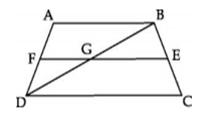 In trapezium ABCD, AB||DC and DC = 2AB.
Also,
In trapezium ABCD, AB||DC and DC = 2AB.
Also,  In trapezium ABCD, EF||AB||CD, using BPT,
 In
In  BGE and BDC,
 B = B(Common)
BEG = BCD(Corresponding angles)
B = B(Common)
BEG = BCD(Corresponding angles)
 As,
As, 




 (1)
Similarly, DGF
(1)
Similarly, DGF  DBA
DBA

 FG =
FG =  AB(2)
AB(2)
 Adding (1) and (2),
EG + FG =
Adding (1) and (2),
EG + FG =  CD + AB
EF = (2AB) + AB =
CD + AB
EF = (2AB) + AB =  AB + AB =
  AB
AB
 7EF = 11 AB
Q110. In
trapezium ABCD, AB is parallel to CD and AB = 2 CD. If area of  AOB = 84 cm2, find the area of COD.
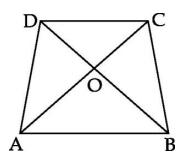
AOB = 84 cm2, find the area of COD.
Solution
Give, AB || CD



Q111. E and F are points on the sides PQ and PR respectively of a  PQR. State whether EF || QR. PE = 3.9cm, EQ = 3cm, PF =3.6cm and FR = 2.4cm.
PQR. State whether EF || QR. PE = 3.9cm, EQ = 3cm, PF =3.6cm and FR = 2.4cm.Solution
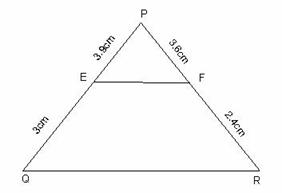


 ,
Hence EF is not parallel to QR
,
Hence EF is not parallel to QR
Q112. In
the given figure,  PQR is an isosceles triangle with PQ = PR. S is a
point on QR and T is a point on QP produced such that
PQR is an isosceles triangle with PQ = PR. S is a
point on QR and T is a point on QP produced such that  , prove that
  .
.
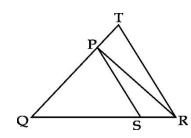
PQR is an isosceles triangle with PQ = PR. S is a
point on QR and T is a point on QP produced such that , prove that .
Solution
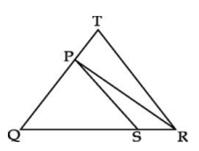
 or
or
 Now
in
Now
in 
 PQS
= TQR
[common]
PQS
= TQR
[common]
 PQS
PQS  TQR [SAS
similarity]
TQR [SAS
similarity]
Q113. D,
E and F are respectively the mid-points sides PQ, QR and PR of  PQR. Find the ratio of the areas of DEF and RPQ.
PQR. Find the ratio of the areas of DEF and RPQ.Solution
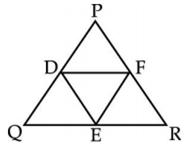 D,
E and F are mid-points of PQ, QR and PR
D,
E and F are mid-points of PQ, QR and PR
 DE||PR
and DF||QR
DE||PR
and DF||QR
 DE||FR
and DF||ER
DE||FR
and DF||ER
 DERF is a ||
gm
Similarly,
DEFP is a || gm
Now,
in DEF and RPQ,
DERF is a ||
gm
Similarly,
DEFP is a || gm
Now,
in DEF and RPQ,
 DEF
= P
FDE
= R
[Opposite
angle of a || gm are equal]
DEF
DEF
= P
FDE
= R
[Opposite
angle of a || gm are equal]
DEF  RPQ [AA
similarity]
RPQ [AA
similarity]


 Required ratio is 1 : 4
Q114. The area of a rectangular field is 200 sq m and its perimeter is 60 m. What is the length of its diagonal?
Solution
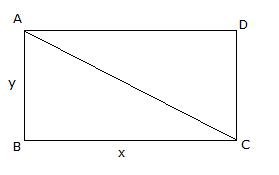
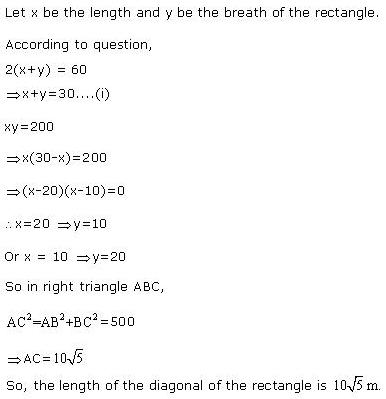
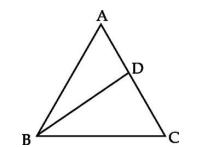
Q115. In  ABC, AB = AC and D is a point on side AC such that BC2 = AC.CD. Prove that BD = BC.
ABC, AB = AC and D is a point on side AC such that BC2 = AC.CD. Prove that BD = BC.Solution
BC2 = AC  CD
CD
 ... (1)
 In DBC and BAC,
[From (1)]
In DBC and BAC,
[From (1)]
 BCD = ACB [Common]
DBC
BCD = ACB [Common]
DBC  BAC [By SAS similarity criterion]

CD
... (1)
In DBC and BAC,
[From (1)]
BCD = ACB [Common]
DBC BAC [By SAS similarity criterion]
Q116. In figure, P, Q and R are respectively the mid-points of sides AB, BC and CA of  ABC. Show that ar (PBQR) =
  ar(ABC)
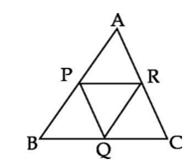
ABC. Show that ar (PBQR) = ar(ABC)
Solution
Here, PR = BC, PQ = AC, QR = AB
[ P, Q, R are mid-points of AB, BC, CA]


 Now, PR||BC and QR||AB
 PR||BQ and QR||PB
 PBQR is a parallelogram
ar(PBQR) = 2 ar (PQR) ...(2)
From (1) and (2),
ar (PBQR) = 2
PBQR is a parallelogram
ar(PBQR) = 2 ar (PQR) ...(2)
From (1) and (2),
ar (PBQR) = 2 
 ar (CAB) = ar (CAB)
Hence proved.
ar (CAB) = ar (CAB)
Hence proved.
Q117. 
Solution
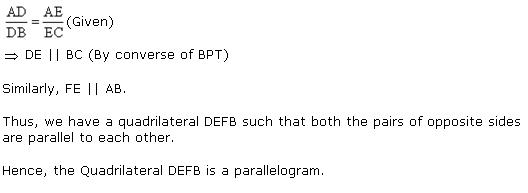
Q118. Prove that the sum of the squares of the sides of a rhombus is equal to the sum of the squares of its diagonals.
Solution
 Given: ABCD is a rhombus
To prove: AB2 + BC2 + CD2 + AD2 = AC2 + BD2
Proof:
We know, diagonals of a rhombus bisect at right angles.
Therefore, from triangle AOB,
AB2 = AO2 + OB2
Given: ABCD is a rhombus
To prove: AB2 + BC2 + CD2 + AD2 = AC2 + BD2
Proof:
We know, diagonals of a rhombus bisect at right angles.
Therefore, from triangle AOB,
AB2 = AO2 + OB2

 4AB2 = AC2 + BD2
Thus, AB2 + BC2 + CD2 + DA2 = 4AB2 = AC2 + BD2
[As AB = BC = CD = DA]
4AB2 = AC2 + BD2
Thus, AB2 + BC2 + CD2 + DA2 = 4AB2 = AC2 + BD2
[As AB = BC = CD = DA]
Q119. In  and D is a point on side AC such that BC2
= AC.CD. Show that BD = BC
and D is a point on side AC such that BC2
= AC.CD. Show that BD = BC
and D is a point on side AC such that BC2
= AC.CD. Show that BD = BCSolution
 BC2
= AC
BC2
= AC  CD
CD


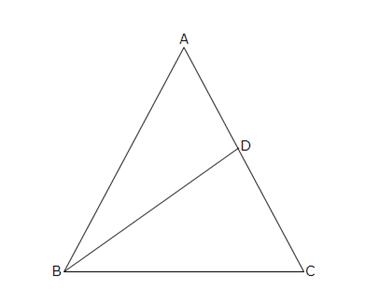



 BD = BC
Q120. If
the areas of two similar triangles are equal, then show that triangles are
congruent.
Solution
Let
 Given,
ar(
Given,
ar( ABC) = ar(PQR)
 We know that the ratio of areas of two similar
triangles is
equal to the square of the ratio of their corresponding sides.
We know that the ratio of areas of two similar
triangles is
equal to the square of the ratio of their corresponding sides.

 AB = PQ; BC = QR ; AC = PR
 ABC
ABC
 PQR [By SSS
congruency criterion]
PQR [By SSS
congruency criterion]
Given,
ar(ABC) = ar(PQR)
We know that the ratio of areas of two similar
triangles is
equal to the square of the ratio of their corresponding sides.
AB = PQ; BC = QR ; AC = PR
ABC
PQR [By SSS
congruency criterion]
Q121. In
given figure, AB || DE and BD||EF.
Prove
that DC2 = CF  AC.
AC.
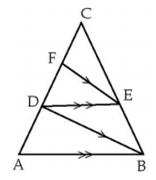
AC.
Solution
In
 CDB, EF||BD,
 (by BPT) ...(1)
In
CAB, DE||AB,
(by BPT) ...(1)
In
CAB, DE||AB,
 (by BPT) ...(2)
From
(1) and (2),
(by BPT) ...(2)
From
(1) and (2),
 DC2
= CF AC
DC2
= CF AC
CDB, EF||BD,
(by BPT) ...(1)
In
CAB, DE||AB,
(by BPT) ...(2)
From
(1) and (2),
DC2
= CF AC
Q122. Two similar triangles ABC and DEF are such that their perimeters are 30 cm and 18 cm respectively.If AB=6,then find DE.
Solution
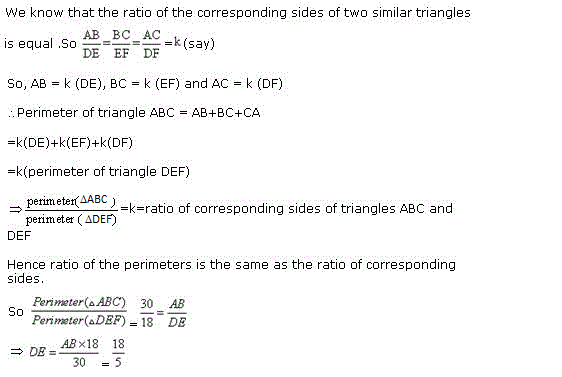
Q123. If the areas of two similar triangles are equal, prove that they are congruent.
Solution
Let  ABC
ABC  DEF
We know that the ratio of areas of two similar triangles is equal to the ratio of squares of their corresponding sides.
Given, ar (ABC) = ar (DEF)
DEF
We know that the ratio of areas of two similar triangles is equal to the ratio of squares of their corresponding sides.
Given, ar (ABC) = ar (DEF)

 AB = DE, BC = EF, AC = DF
 ABC
ABC  DEF by Side-Side-Side criterion of congruency.
ABC DEF
We know that the ratio of areas of two similar triangles is equal to the ratio of squares of their corresponding sides.
Given, ar (ABC) = ar (DEF)
AB = DE, BC = EF, AC = DF
ABC DEF by Side-Side-Side criterion of congruency.
Q124. In
figure below, DE||BC and AD:DB = 5:4. Find 
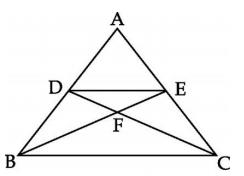
Solution
In  ABC, DE||BC
 ABC
= ADE, ACB = AED
[corresponding s]
ABC
= ADE, ACB = AED
[corresponding s]
 ABC
ABC  ADE (AA
similarity)
ADE (AA
similarity)


 1
+
1
+  = 1 +
= 1 + 
 Now, in triangles DEF and CBF, we have:
FDE
= BCF
DEF
= FBC
[Alternate
s]
DEF CBF
[AA similarity]
Now, in triangles DEF and CBF, we have:
FDE
= BCF
DEF
= FBC
[Alternate
s]
DEF CBF
[AA similarity]

ABC, DE||BC
ABC
= ADE, ACB = AED
[corresponding s]
ABC ADE (AA
similarity)
1
+ = 1 +
Now, in triangles DEF and CBF, we have:
FDE
= BCF
DEF
= FBC
[Alternate
s]
DEF CBF
[AA similarity]
Q125. Prove that the line segment joining the mid points of any two sides of a triangle is parallel to the third side.
Solution
In  ABC, D and E are mid points of AB and AC respectively
to prove DE II BC.
ABC, D and E are mid points of AB and AC respectively
to prove DE II BC.
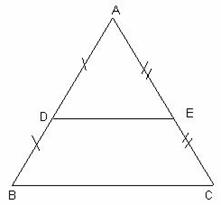
 as D is mid point of AB (1)
Similarly
as D is mid point of AB (1)
Similarly  (2)
Hence from (1) and (2)
(2)
Hence from (1) and (2)
 by converse of BPT
DE II BC. Hence proved.
by converse of BPT
DE II BC. Hence proved.
ABC, D and E are mid points of AB and AC respectively
to prove DE II BC.
as D is mid point of AB (1)
Similarly (2)
Hence from (1) and (2)
by converse of BPT
DE II BC. Hence proved.
Q126. 
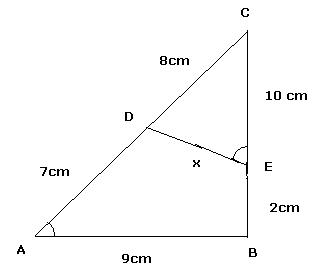
Solution

Q127. In the given figure, in  ABC, XY||AC and XY divides the ABC into two regions such that ar(BXY) = 2ar (ACYX). Determine
  .
.
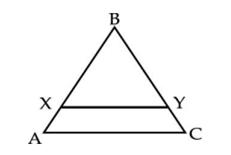
ABC, XY||AC and XY divides the ABC into two regions such that ar(BXY) = 2ar (ACYX). Determine .
Solution
ar(BXY) = 2ar (ACYX)
ar(BXY) = 2 [ar(BAC) - ar(BXY)]
ar(BXY) = 2ar (BAC) - 2 ar(BXY)
3 ar (BXY) = 2ar (BAC)
 ...(1)
In BXY and BAC,
...(1)
In BXY and BAC,
 B = B (Common)
BXY = BAC (Alternate angles, as XY || AC)
B = B (Common)
BXY = BAC (Alternate angles, as XY || AC)
 BXY
BXY  BAC (AA similarity)


 [Using (1)]




...(1)
In BXY and BAC,
B = B (Common)
BXY = BAC (Alternate angles, as XY || AC)
BXY BAC (AA similarity)
[Using (1)]
Comments
Post a Comment